Hi, it's me again! Hard to believe it's been nearly three months. Work, wedding planning, and life have pushed blogging to the back burner. A coworker and I recently made a pact that we would both begin blogging again (she writes a fantastic blog about fashion for tall women); the goal is once per week - let's see how this goes.
I think one of the more valuable things I learned over the last few busy months is that sometimes you don't have to ask how you got somewhere - occasionally it's just better to press on and strive for improvement. In that spirit, let's pick up with a delicious meal from last week! For my birthday last year Nick's brother and sister-in-law got me a fantastic cookbook by Top Chef Stephanie Izard: Girl in the Kitchen. The photography is beautiful, and I'm getting excited for spring and summer (about time, New England) looking at seasonal recipes.
I adapted this recipe by adding some cold soba noodles for a little more dinner heft, and it was perfect. Tons of flavor but not overly heavy, this salad was the perfect transition into spring. The tangy dressing lightly pickles the crunchy radish slices, and the blueberries add a sweet pop of juicy flavor to balance the smoky seared tuna and bite from the sriracha.
*
Seared Tuna with Blueberries and Snap Peas
(Serves 4)
Dressing:
3 T rice vinegar
2 T extra virgin olive oil
1 T minced shallot
1/2 lemon, zested
1 t Dijon mustard
1 t honey
1/4 t sriracha
salt
freshly ground pepper
Salad
1 lb ahi tuna
1 T canola oil
salt
freshly ground pepper
8 oz sugar snap peas, cut on a bias (diagonal) into thin strips
1 c thinly sliced radish
1 c fresh blueberries
2/3 c chiffonade sorrel (I couldn't find sorrel, so I used baby spinach and doubled the amount)
1/2 c pine nuts, toasted
8 oz soba noodles, cooked
Whisk together vinegar, olive oil, shallot, lemon zest, mustard, honey, and sriracha in a small bowl. Season to taste with salt and pepper.
Prepare your veggies: Nick's mom got me a mandoline slicer one year for Christmas, and I made great use of it to make paper-thin radish slices (you can also thinly slice with a regular knife). "Chiffonade" (or cut into strips) the sorrel or spinach into delicious confetti.
Season the tuna with salt and pepper. Heat a frying pan over high heat and add the canola oil just before searing the tuna (this will smoke like crazy - but only for a matter of seconds as this is really a flash in the pan). Sear each side for a minute and a half; the inside will be nice and rare. Transfer to a cutting board and cut into 1/4" slices (cut across the grain, or else it will fall apart).
Combine snap peas, radish, blueberries, sorrel/spinach, pine nuts, soba noodles, and dressing. Toss well. Lay seared tuna over the salad and serve.
Showing posts with label chefs. Show all posts
Sunday, May 11, 2014
Monday, February 4, 2013
Short ribs go a long way.
Short ribs are a dish I've always considered to be too time-consuming and decadent to make at home. As part of a New Year's resolution to cook more at home (yes, even we who love to cook sometimes run out of time when moving/getting settled into a new job, apartment, and city), I dusted off the cookbook sent by dear family friends (Simple to Spectacular) and found a whole section on short ribs. The good news was most of the cook time was hands-off (I managed to work in a workout and some quality TV watching), and the technique itself wasn't that complicated -- don't let the length of the recipe or ingredients list fool you.
When one of my sisters moved back to Boston a couple years ago, we ate at Jean Georges' Market (home of an extremely reasonable and delicious prix fixe menu), where we had the most intensely flavorful, melt-in-your-mouth short ribs I've ever experienced. As Jean Georges is the co-author of my fabulous cookbook, I hoped to find something in that short ribs section to replicate our experience. His cooking style is what fancy food folk call "New French," influenced by Asian flavors, among others. My kitchen became quite the melting pot as we took a single recipe (soy glazed short ribs) and dressed it two ways:
The first night we followed the book recipe, which highlighted the Asian flavors of soy, star anise, and ginger, serving over a bed of ginger-steamed bok choy, water chestnuts, and jasmine rice:
Short Rib Tips for Success:
When one of my sisters moved back to Boston a couple years ago, we ate at Jean Georges' Market (home of an extremely reasonable and delicious prix fixe menu), where we had the most intensely flavorful, melt-in-your-mouth short ribs I've ever experienced. As Jean Georges is the co-author of my fabulous cookbook, I hoped to find something in that short ribs section to replicate our experience. His cooking style is what fancy food folk call "New French," influenced by Asian flavors, among others. My kitchen became quite the melting pot as we took a single recipe (soy glazed short ribs) and dressed it two ways:
The first night we followed the book recipe, which highlighted the Asian flavors of soy, star anise, and ginger, serving over a bed of ginger-steamed bok choy, water chestnuts, and jasmine rice:
The second night we refocused on our Market experience, highlighting the tangy acidity by adding julienned green apples and lemon zest, serving over creamy mashed potatoes and spicy Swiss chard (who says leftovers have to be boring?):
Both were delicious and quite different, and we were happy to get two distinct flavor profiles out of a solid Sunday evening's worth of cooking.Short Rib Tips for Success:
- If they don't have bone-in short ribs in the store, get boneless but ask for additional beef bones to flavor the braising liquid.
- Season the meat liberally before cooking: coarse salt and pepper are all you need to begin.
- Taste your braising liquid before it starts to cook down: it will only get better, but you want to know you're starting in a good place. If you need to add more soy, ginger, or any other flavor, adjust.
- Don't rush the braise: take your time, and save plenty for leftovers because these microwave well and taste even better the second time around. I highly recommend this recipe for company, as it can be made days in advance and only gets more delicious with time.
*
Asian Spiced Short Ribs with Ginger-Steamed Bok Choy
Serves 6-8
1/4 c canola oil
4 lb beef short ribs, preferably bone-in
Kosher salt and freshly ground black pepper
1 large onion, coarsely chopped
4 garlic cloves, smashed
1/4 c fresh ginger, cut into large pieces + 1 T fresh ginger, finely grated
2 T sugar
5 star anise
1 dried chile
2 T Szechwan peppercorns
20 cilantro stems
1 c dry sherry
1/2 c low-sodium soy sauce
10 oz canned water chestnuts, rinsed and quartered
3 slices ginger
4 medium heads of bok choy, washed and cut into 1" pieces
minced cilantro leaves for garnish
Ribs: Preheat the oven to 350*F. Heat 2 T oil in a Dutch oven on medium-high heat. Season ribs liberally with coarse salt and pepper, then brown well on all sides (this will take about 20 min., and you'll probably need to brown them in batches). Remove the ribs to a plate and turn off the heat.
Heat the remaining 2 T of oil over medium. Add the onion, garlic, large ginger pieces (reserve the grated ginger) and sugar, and cook, stirring, until everything is very soft and browned, about 12 minutes.
Add the star anise, dried chile, Szechwan peppercorns and cilantro stems to the pot. Cook for a minute, then add the sherry, soy, and 3 c water. Add the ribs back to the pot. Snuggle the bones down into the braising liquid until mostly covered. Cover the pot and cook the ribs in the oven until they are tender and the meat is falling from the bones, about 3 hr. Turn the bones every half hour or so.
Transfer the ribs to a plate and strain the cooking liquid. The book says to refrigerate the sauce overnight and skim off the fat, which made it a little more visually appealing, but wasn't totally necessary. You will want to reduce the sauce some, at a rolling boil until somewhat thickened and more concentrated. Heat water chestnuts through.
Bok Choy: Bring water and sliced ginger to a boil. Put a strainer over the water and add the bok choy, then cover with the pot lid and steam until cooked the way you like them (I like mine fairly al dente), just a few minutes.
Serve: Stack ribs on bok choy and spoon sauce over them liberally, serving with Jasmine rice; garnish with chopped cilantro and serve.
Tuesday, November 6, 2012
Back to School
Faithful readers -- it's been way too long.
My apartment is partially unpacked, partially painted, and a complete mess -- the last few weeks have been slightly crazy, with the usual moving struggles but also some unexpected challenges (a newly discovered severe dust mite allergy, industrial-strength primer and paint to cover a smoky smell in the new place). Fortunately, I've had plenty of help from friends and family, and it's finally starting to feel like home.
I'm settling in nicely at the new job, and my evenings and weekends are kept busy visiting old friends still in the area, going to a college friend's wedding (enjoying a short reunion with a few former roommates), and meeting my parents for a weekend in New York.
Between all the work and play, I've even found a couple opportunities to go back to my alma mater for a superb public lecture series: Science and Cooking: From Haute Cuisine to the Science of Soft Matter. This semester-long course brings in famous chefs such as Wylie Dufresne and David Chang, covering topics ranging from molecular gastronomy to the art of sous-vide. Each chef describes his/her craft and passion for cooking, and together with the course faculty perform live demos to teach basic chemistry and physics concepts involved in cooking and baking. Basically, it's truly optimal entertainment for Nick (the scientist) and me (the amateur chef). We've attended two lectures: the first by Jose Andres, particularly appropriate considering he owns several restaurants in the DC area; and the second by Joanne Chang, owner of one of my very favorite restaurant/bakeries in town (previously featured on the blog), Flour.
Chef Andres introduced us to his organization, the Think Food Group, which includes his restaurants as well as an innovative food and beverage R&D team, and a philanthropy group. He showed us how he experiments with forms and phases of matter for a playful take on traditional dishes (a gorgeous, Chihuly-inspired clear sugar dessert filled with olive oil), shared a new restaurant concept (coming soon), and described his team's great work in Haiti.
Chef Chang talked all about the science of baking ("bakistry"), focusing on the key ingredients that make cake cake (there were highly successful samples distributed throughout the lecture hall). It was fascinating to learn about the role of leavening agents, fats, acids (who knew chocolate was acidic??), sugar, and flour, and how each one contributes to velvety, tender cake. She explained the science behind much of the kitchen knowledge which we experienced cake lovers take for granted (don't overmix batter (to keep from developing gluten, making the cake chewy), use buttermilk with baking soda together (the acid reacts and generates bubbles which give the cake lift)).
While the science in the evening lectures is light and fairly digestible (haha), the full-time class gets into much more difficult concepts. Let me tell you, if it had been offered when I was an undergrad, I would have fought tooth and nail to get on the roster. Boston locals, I highly recommend attending any one of the (free!) lectures left in the series...they're fun, educational, and quite tasty.
My apartment is partially unpacked, partially painted, and a complete mess -- the last few weeks have been slightly crazy, with the usual moving struggles but also some unexpected challenges (a newly discovered severe dust mite allergy, industrial-strength primer and paint to cover a smoky smell in the new place). Fortunately, I've had plenty of help from friends and family, and it's finally starting to feel like home.
I'm settling in nicely at the new job, and my evenings and weekends are kept busy visiting old friends still in the area, going to a college friend's wedding (enjoying a short reunion with a few former roommates), and meeting my parents for a weekend in New York.
Between all the work and play, I've even found a couple opportunities to go back to my alma mater for a superb public lecture series: Science and Cooking: From Haute Cuisine to the Science of Soft Matter. This semester-long course brings in famous chefs such as Wylie Dufresne and David Chang, covering topics ranging from molecular gastronomy to the art of sous-vide. Each chef describes his/her craft and passion for cooking, and together with the course faculty perform live demos to teach basic chemistry and physics concepts involved in cooking and baking. Basically, it's truly optimal entertainment for Nick (the scientist) and me (the amateur chef). We've attended two lectures: the first by Jose Andres, particularly appropriate considering he owns several restaurants in the DC area; and the second by Joanne Chang, owner of one of my very favorite restaurant/bakeries in town (previously featured on the blog), Flour.
Chef Andres introduced us to his organization, the Think Food Group, which includes his restaurants as well as an innovative food and beverage R&D team, and a philanthropy group. He showed us how he experiments with forms and phases of matter for a playful take on traditional dishes (a gorgeous, Chihuly-inspired clear sugar dessert filled with olive oil), shared a new restaurant concept (coming soon), and described his team's great work in Haiti.
Chef Chang talked all about the science of baking ("bakistry"), focusing on the key ingredients that make cake cake (there were highly successful samples distributed throughout the lecture hall). It was fascinating to learn about the role of leavening agents, fats, acids (who knew chocolate was acidic??), sugar, and flour, and how each one contributes to velvety, tender cake. She explained the science behind much of the kitchen knowledge which we experienced cake lovers take for granted (don't overmix batter (to keep from developing gluten, making the cake chewy), use buttermilk with baking soda together (the acid reacts and generates bubbles which give the cake lift)).
While the science in the evening lectures is light and fairly digestible (haha), the full-time class gets into much more difficult concepts. Let me tell you, if it had been offered when I was an undergrad, I would have fought tooth and nail to get on the roster. Boston locals, I highly recommend attending any one of the (free!) lectures left in the series...they're fun, educational, and quite tasty.
Thursday, July 12, 2012
Bev's Place.
When I was little, I was the executive chef of a fabulous restaurant. I wrote the menus (my specials were always spaghetti or mac and cheese) and designed the decor (the finest plastic serveware I could get). While my mom would cook dinner, I would chop, saute, and braise in my Fisher Price kitchen. My restaurant was called "Bev's Place," and our clientele included A-list celebrities such as Winnie the Pooh, Piglet, and the rest of my army of stuffed animals...with an occasional guest appearance by a babysitter or an older sister's American Girl.It was my childhood dream to become a chef.
Two decades later, as you know, the chef thing didn't exactly happen, but I still love to cook for friends and family. Last weekend, I cooked my first "tasting menu," a thesis of sorts: it was the final result after years of being a sous chef to my mom, studying menus and flavors in great restaurants, and taking copious mental notes while watching the Food Network and Top Chef. Inspired by the special meals I've been fortunate to try as well as the favorite foods of a Special Someone, I presented my first degustation (and you'd better believe mac and cheese was on the menu).
I planned ahead quite a bit and managed to prepare many of the sauces and components (including a few ice creams) several days in advance. Still, the trouble with being the executive chef, sous chef, saucier, sommelier, waiter, and maitre d', is that these multiple roles make it nearly impossible to be your fellow diner's date...next time, perhaps I'll hire wait staff. The presentation was a little rough around the edges, but all things considered, I surprised myself and was thoroughly pleased with the final result (doneness, temperature, and flavors -- it was all there). I had so much fun creating the menu, and most importantly, Nick loved it all.
*
Amuse-bouche: Summer asparagus soup shooter with truffle-buttered brioche toasts and a fried quail egg with black truffle salt.
The inspiration: A bite-sized play on the classic asparagus-egg combo (asparagus being Nick's favorite vegetable).
First course: Shiitake dumplings in a ginger-bacon broth.
The inspiration: A play on a dumpling-dashi dish I once had, substituting smoky bacon (Nick's other true love) for smoky bonito.
Fish course: (apologies for the hasty photography -- you know how I feel about cold fish) a seed-and-nut-crusted halibut filet over a rosemary-lima bean puree drizzled with mushroom beurre-noisette, served with hand-rolled herb gnocchi.
The inspiration: A slight twist on a recipe from my new favorite cookbook, Jean-Georges' Simple to Spectacular, accompanied by Nick's favorite, gnocchi (here's a recipe for the base: I added fresh oregano and chives).
Palate cleanser: Meyer lemon sorbet.
The inspiration: A similar dish (I swapped Meyer lemons for the original oranges), also from Simple to Spectacular.
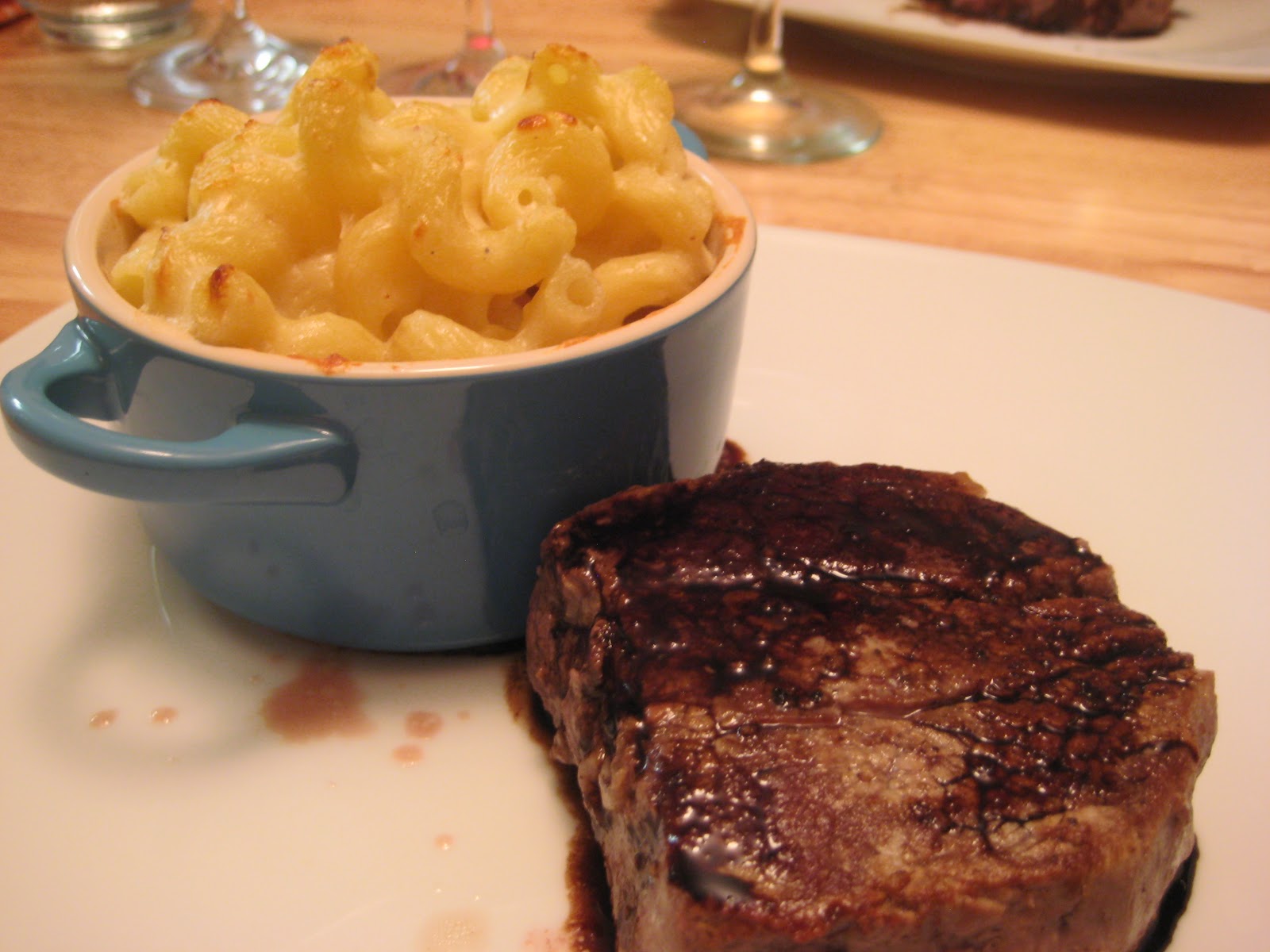
Meat course: Seared filet mignon with a balsamic reduction, white truffle mac and cheese.
The inspiration: A twist on a classic steakhouse meal (since Nick and I both have a soft spot for mac and cheese, the old Bev's Place stand-by was right at home).
Chocolate dessert: Homemade ice cream duo: peanut butter ice cream in an edible chocolate cup with honey roasted peanuts; salted caramel-bacon ice cream.
The inspiration: Nick's all-time favorite dessert combination (chocolate and peanut butter) and his latest flavor-fav, salted caramel (which obviously called for bacon as well).
Two decades later, as you know, the chef thing didn't exactly happen, but I still love to cook for friends and family. Last weekend, I cooked my first "tasting menu," a thesis of sorts: it was the final result after years of being a sous chef to my mom, studying menus and flavors in great restaurants, and taking copious mental notes while watching the Food Network and Top Chef. Inspired by the special meals I've been fortunate to try as well as the favorite foods of a Special Someone, I presented my first degustation (and you'd better believe mac and cheese was on the menu).
I planned ahead quite a bit and managed to prepare many of the sauces and components (including a few ice creams) several days in advance. Still, the trouble with being the executive chef, sous chef, saucier, sommelier, waiter, and maitre d', is that these multiple roles make it nearly impossible to be your fellow diner's date...next time, perhaps I'll hire wait staff. The presentation was a little rough around the edges, but all things considered, I surprised myself and was thoroughly pleased with the final result (doneness, temperature, and flavors -- it was all there). I had so much fun creating the menu, and most importantly, Nick loved it all.
*
Amuse-bouche: Summer asparagus soup shooter with truffle-buttered brioche toasts and a fried quail egg with black truffle salt.
The inspiration: A bite-sized play on the classic asparagus-egg combo (asparagus being Nick's favorite vegetable).
First course: Shiitake dumplings in a ginger-bacon broth.
The inspiration: A play on a dumpling-dashi dish I once had, substituting smoky bacon (Nick's other true love) for smoky bonito.
Fish course: (apologies for the hasty photography -- you know how I feel about cold fish) a seed-and-nut-crusted halibut filet over a rosemary-lima bean puree drizzled with mushroom beurre-noisette, served with hand-rolled herb gnocchi.
The inspiration: A slight twist on a recipe from my new favorite cookbook, Jean-Georges' Simple to Spectacular, accompanied by Nick's favorite, gnocchi (here's a recipe for the base: I added fresh oregano and chives).
Palate cleanser: Meyer lemon sorbet.
The inspiration: A similar dish (I swapped Meyer lemons for the original oranges), also from Simple to Spectacular.
Meat course: Seared filet mignon with a balsamic reduction, white truffle mac and cheese.
The inspiration: A twist on a classic steakhouse meal (since Nick and I both have a soft spot for mac and cheese, the old Bev's Place stand-by was right at home).
Chocolate dessert: Homemade ice cream duo: peanut butter ice cream in an edible chocolate cup with honey roasted peanuts; salted caramel-bacon ice cream.
The inspiration: Nick's all-time favorite dessert combination (chocolate and peanut butter) and his latest flavor-fav, salted caramel (which obviously called for bacon as well).
Fruit dessert: Meringue-berry "pizza."
The inspiration: It's not an homage to Nick's favorites unless there's pizza involved; a white meringue disk with fresh raspberry coulis and blackberries.
Labels:
chefs,
childhood,
date night,
dessert,
entertaining,
experiments,
family,
home,
new experiences,
new techniques
Thursday, June 7, 2012
Surprise center.
Few know more about natural food than Heidi Swanson, the culinary genius behind the blog, 101Cookbooks, and a 2012 James Beard winner. Her new book, Super Natural Every Day, is filled with healthful, delicious recipes using all-natural ingredients. The beautiful photography and writing inspire even the most white-flour chefs among us to try her recipes.
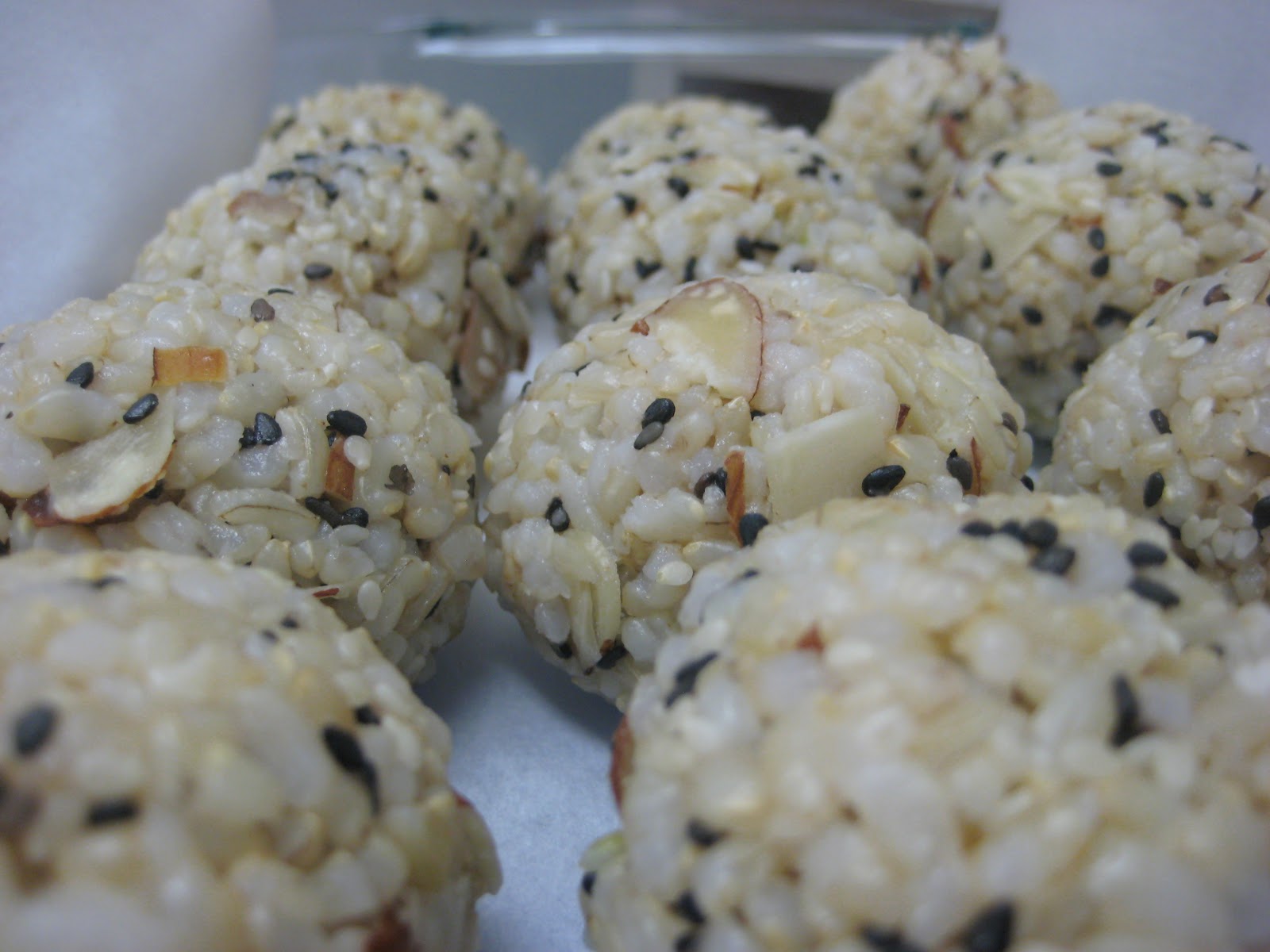
Her post about Sesame Almond Brown Rice Balls was so cute that I immediately searched high and low for black sesame seeds (not an integral part of the dish by any means, but a cute addition I had to have). Specialty food store after supermarket failed me, and I was only rescued by my mom bringing me a little pouch of black sesame seeds from home on one of our whirlwind-weekend New York trips.
Sesame seeds in hand, I made the rice and started rolling. As Heidi says, you can put pretty much anything in the center of these little munchkins. I chose avocado for one batch and marinated cubes of tofu for the other. (See? Her recipes inspire me to use tofu.) In the end, they hand-rolling wasn't quite as tedious as I feared they would be, and they tasted even better after a couple days in the refrigerator.
Two tips: I would try to minimize the amount of rice for each ball while still covering the secret center, as they were quite filling. Also, take care with the seasoning -- you don't want to put too much salt in the ball itself because the dipping soy sauce will be quite salty. Do give the avocado a dash of salt when you're tossing it with the lemon, though, since it takes a while for the soy to hit the center when eating them. I ate two or three of these at a time with some Chinese vegetables in soup, which made for a light and delicious meal.
*
Sesame Almond Brown Rice Balls
(101 Cookbooks)
Makes 2 dozen
2 c (when measured raw) brown sushi rice, cooked (I used a rice cooker, and it worked perfectly)
3 c water
1/2 t sea salt
1/4 c sesame seeds (white/black mix)
3 T toasted almond slices/slivers, chopped
1/4 c minced green onions
In the center: avocado cubes tossed in lemon juice and salt; tofu marinated in my "Hero" sauce
To form the rice balls, line a small cup/ramekin with plastic wrap, then fill with 1 1/2 - 2 T of the rice mixture. Place your "surprise center" in the middle, then gather the plastic wrap at the top and twist to seal the center inside the rice ball. Using your other palm, shape the rice into a ball. Carefully remove plastic wrap and set the rice ball in a parchment lined container or on a plate. Repeat with the remaining rice. Serve with a dish of soy sauce.
Heidi's tips: If your fingers get sticky, dab with water. And if you run out of steam making rice balls, just cook up a couple eggs into a thin omelette, cut into shreds, and toss with the rice.
Monday, May 14, 2012
Mom's the word.
I went to New York for another whirlwind weekend with my family -- this time celebrating Mother's Day. We had a lovely weekend walking in the gorgeous weather, complete with shopping and good food as usual. We browsed a fabulous rare bookstore, where we found signed first editions of some of our childhood favorites including The House at Pooh Corner, going for $2800. Some books were easily in the tens of thousands, and the most expensive crested into six figures. Needless to say, we didn't buy anything, but we loved finding our old favorites on the shelves. (It's actually been a bit of a tradition of my sisters over the last few years, finding and buying our favorite out-of-print children's books and giving them to Mom for various holidays.)
This weekend we were celebrating not only Mother's Day but also Mom's graduation from an MBA program (her second Master's) which she just finished last week. She's been taking classes online and on the ground for the last few years, and we couldn't be prouder or more excited for her. It seems a little odd, being "proud" of your parents, but I can't think of any other word for it. In my years growing up, it's an understatement to say she was always there: shuttling me from school to various activities, lessons, practices, and rehearsals; quizzing me on spelling words, vocabulary, the periodic table; helping me glue captions on posters in the wee small hours of the morning, bringing me sliced fruit and snacks to keep me going. I just wish I could have been there to do the same as she managed getting her MBA while still running her normal life simultaneously.
An appropriately sumptuous dinner at Daniel marked both the graduation and Mother's Day occasions. Our waiter asked if there was a special occasion, and when we told him, he was so enthusiastic that he brought us not one but TWO surprise dessert plates in addition to what we ordered. Another excellent surprise, Chef Daniel himself actually walked around the dining room, but he had to leave ("for a dinner reservation") before he got to our table (I was a little star-struck anyway).
The tasting menu offered two options for every course, so we basically had the good fortune of a double tasting menu by making sure someone ordered each option for each course. Since the menu ended up being so enormous, here is just a sampling of my favorites from the evening:
Amuse bouche trio featuring spring peas: my favorite "bite" of the three was shrimp with pea puree and a pickled hon-shimeji mushroom
First course: Mosaic of poularde, foie gras, and daikon radish set in black trumpet gelee with hazelnuts
Second course: Maine peekytoe crab salad with hibiscus gelee, compressed cucumber, mint oil, and anise hyssop salad
Third course: Mousseron and Swiss chard ravioli with fiddlehead ferns
Fourth course: there was a salmon option, but I substituted a red wine reduction-marinated sea bass with bechamel braised leek and a crispy potato crouton (for the record, the cedar-wrapped salmon with bourbon sauce was so delicious and tender that I missed photographing that one as well)
Fifth course: Duo of beef: an insanely flavorful braised short rib with carrot puree, seared Wagyu tenderloin with crispy rosemary polenta and a spring garlic confit
Dessert: Molten Guanaja chocolate cake with milk sorbet
Passion fruit-vanilla vacherin with mango-passion fruit chutney, mascarpone chantilly, and crispy meringue wafers
This weekend we were celebrating not only Mother's Day but also Mom's graduation from an MBA program (her second Master's) which she just finished last week. She's been taking classes online and on the ground for the last few years, and we couldn't be prouder or more excited for her. It seems a little odd, being "proud" of your parents, but I can't think of any other word for it. In my years growing up, it's an understatement to say she was always there: shuttling me from school to various activities, lessons, practices, and rehearsals; quizzing me on spelling words, vocabulary, the periodic table; helping me glue captions on posters in the wee small hours of the morning, bringing me sliced fruit and snacks to keep me going. I just wish I could have been there to do the same as she managed getting her MBA while still running her normal life simultaneously.
An appropriately sumptuous dinner at Daniel marked both the graduation and Mother's Day occasions. Our waiter asked if there was a special occasion, and when we told him, he was so enthusiastic that he brought us not one but TWO surprise dessert plates in addition to what we ordered. Another excellent surprise, Chef Daniel himself actually walked around the dining room, but he had to leave ("for a dinner reservation") before he got to our table (I was a little star-struck anyway).
The tasting menu offered two options for every course, so we basically had the good fortune of a double tasting menu by making sure someone ordered each option for each course. Since the menu ended up being so enormous, here is just a sampling of my favorites from the evening:
Amuse bouche trio featuring spring peas: my favorite "bite" of the three was shrimp with pea puree and a pickled hon-shimeji mushroom
First course: Mosaic of poularde, foie gras, and daikon radish set in black trumpet gelee with hazelnuts
Second course: Maine peekytoe crab salad with hibiscus gelee, compressed cucumber, mint oil, and anise hyssop salad
Third course: Mousseron and Swiss chard ravioli with fiddlehead ferns
Fourth course: there was a salmon option, but I substituted a red wine reduction-marinated sea bass with bechamel braised leek and a crispy potato crouton (for the record, the cedar-wrapped salmon with bourbon sauce was so delicious and tender that I missed photographing that one as well)
Fifth course: Duo of beef: an insanely flavorful braised short rib with carrot puree, seared Wagyu tenderloin with crispy rosemary polenta and a spring garlic confit
Dessert: Molten Guanaja chocolate cake with milk sorbet
Passion fruit-vanilla vacherin with mango-passion fruit chutney, mascarpone chantilly, and crispy meringue wafers
A delightful (and delectable) way to celebrate Mom, all around.
Sunday, April 1, 2012
Top chef, D.C.
As you may have guessed, one of my top DVR spots belongs to the popular TV series, Top Chef. Hosted by Tom Colicchio, Padma Lakshmi, and Gail Simmons, and guest judged by the likes of Eric Ripert, Anthony Bourdain, and Emeril Lagasse; Top Chef brings together up-and-coming chefs from across the country to battle in the kitchen for fame and glory (and, of course, the coveted title of "Top Chef"). Across the years, several chef-testants have come from/own restaurants the D.C. area including Carla Hall, the Voltaggio brothers, Mike Isabella, and Spike Mendelsohn.
Though Top Chef restaurants appear to be all around the neighborhood, after over two years, I had only been to Spike's Good Stuff and We, the Pizza near Capitol Hill. I checked one more off the list last week with a visiting friend in town for a conference. Offering a variety of beers and even prosecco on tap, Mike Isabella's Graffiato is an Italian-inspired, contemporary American spot in Chinatown/Penn Quarter. I would sum up our experience in two words: crispy and flavorful. Everything, even the pillow-soft gnocchi, had an amazing golden crust.
We started off the meal with (crispy) flatbread and Mike's famous pepperoni sauce that he made for the All-Stars Finale:
Wild mushroom gnocchi with creamy stracciatella:
A baked suckling pig (!) lasagna with rich ricotta and what I swear was lemon:
Definitely a Top Chef experience. The only problem was that I spent a quarter of the time craning my neck toward the kitchen hoping Mike Isabella was in.
We started off the meal with (crispy) flatbread and Mike's famous pepperoni sauce that he made for the All-Stars Finale:
Then we moved on to roasted brussel sprouts with pancetta and maple (the brussel sprouts were so crisp, they were like chips):
Wild mushroom gnocchi with creamy stracciatella:
A baked suckling pig (!) lasagna with rich ricotta and what I swear was lemon:
Wild mushroom bisque with smoky mushroom arancini:
A wildly popular burrata with honey glazed onions:
...And we finished off the meal with a wood oven-roasted striped Atlantic bass with smoked eggplant and pine nut relish:
Definitely a Top Chef experience. The only problem was that I spent a quarter of the time craning my neck toward the kitchen hoping Mike Isabella was in.
Labels:
chefs,
D.C.,
date night,
friends,
new experiences,
restaurant review
Sunday, March 18, 2012
Nobu? Yes, please.
Though we cooked most nights we were in Snowmass, we did venture into neighboring Aspen for a couple fabulous dinners. One night we went to Matsuhisa, Chef Nobu's Aspen restaurant. The Japanese-Peruvian/Argentine cuisine was an amazing fusion of flavors, colors, and textures, ranging from seafood crudo to delicately fried tempura and a rich molten chocolate cake. Everything was delicious, and we closed out the restaurant as usual. Ever adventurous, Uncle J ordered uni shooters for everyone (something I would never have touched with a ten foot pole before), which is really super-fresh, raw sea urchin with a raw quail egg, ponzu, and other ingredients I couldn't identify but -- weirdly enough -- enjoyed. (Trying unusual and somewhat intimidating things has become a regular event with Uncle and Auntie J, from skiing double-black diamonds to trying uni shooters.)
In keeping with the "just go with it" theme, we constructed our own Omakase, which translates to "I'll leave it to you" -- it's traditionally a tasting menu designed by the chef including a variety of unannounced vegetable, raw seafood, cooked seafood, and cooked meat courses that show up at the chef's whim. We took each traditional course and filled it with one of our own choices or the waiter's recommendations. Besides the amazing freshness of all of the seafood, one of my favorite aspects of the dinner was the presentation: everything was thoughtful, creative, and so delicate-looking. In the front of the restaurant, Nobu's cookbooks are on display; one showcased a platter of what were actually vegetables made to look like sushi, sashimi, and nigiri (looks pretty real, eh?).
As usual, low-light cell phone photos were all I could manage in the restaurant, so they don't even come close to doing justice to the spectacular dishes presented to us. Regretfully I was also too busy eating to get photos of all of our dishes, so here's just a sampling. I guess you'll just have to go and try it yourself.
Pictured above: A sumptuous sushi platter including toro (fatty tuna belly).
Baby spinach salad with shrimp, shredded bonito, and yuzu-white truffle vinaigrette (the smoky bonito and the zing from the yuzu perfectly balanced the truffle).
Broiled black cod with miso and a delightful, spicy ginger straw.
Molten chocolate cake with ice cream and fresh berries, served in a bento box for dessert.
Mochi: peanut butter and chocolate, one I can't remember (honeydew?), and passionfruit.
Labels:
chefs,
date night,
family,
Fresh,
friends,
new experiences,
restaurant review,
seafood,
travel
Monday, March 12, 2012
Simple and spectacular.
"Thanks for dinner. I've never seen potatoes cooked like that before." ~ Jonah, from Sleepless in Seattle.
Apologies for a bit of a break -- I've been on vacation! My family went to Snowmass, Colorado, where we've been skiing ever since I was a snow cub. We went with some family friends who share our love for skiing and cooking, among other things. Lots of updates from the week to come (both cooking in and eating out), but first I wanted to share a recipe from a book the same family friends gave me a couple weeks ago.
A few weeks ago, Uncle J and Auntie J (nicknames coined over several bottles of wine this past trip) sent me Jean-Georges Vongerichten and Mark Bittman's joint effort, Simple to Spectacular. This amazing cookbook (the photography alone is delicious) consists of 250 recipes, all varying degrees of difficulty off a collection of basic recipes. Each level takes one simple recipe and elevates the technique, ingredients, or other aspect to reach spectacularity. For example, the book starts off with four chicken soup recipes, taking it from a basic "one-hour" chicken stock to a rich, roast chicken stock; then adding lemongrass and ginger for extra depth of flavor, then layering on other ingredients and cook time until the final version is incredibly complex.
My inaugural test recipe was a potato-crusted halibut. The book actually calls for red snapper as the fish and mustard as the sauce base, but I only had halibut, and I figured I could substitute a tart Champagne vinegar for the mustard (with a little adjusting, it turns out I was right). The end result was, in my humble opinion, both simple and spectacular...one of those dishes that looks impressive but is quite easy to execute. The key to the crisp potato crust is to get out as much water as possible and resist the temptation to poke at the fish in the pan while the crust is browning. The tartness of the sauce cuts the salty, earthiness of the potatoes (think ketchup on fries), and the fish was juicy and just tender by the time the potato was cooked. Looking forward to trying more recipes!
*
Sautéed Halibut with Potato Crust
(Adapted from Jean-Georges and Mark Bittman's Sautéed Red Snapper with Potato Crust)
2 medium baking potatoes (about 1.5 lb)
salt and freshly ground black pepper
2 6-oz halibut filets
2 T olive oil
3 T butter
1 c Sauvignon Blanc
2 T chopped shallots
3 T Champagne vinegar
sugar to taste
Peel and grate potatoes, and season with salt. Squeeze grated potato with paper towels to extract the excess liquid. Season fish with salt and pepper, then press a thick layer of potatoes on both sides of each filet.
Preheat the oven to 200ºF. Heat a nonstick skillet over medium-high heat, and add oil and 2 T butter. Add filets to the skillet and cook, turning once, until potato crust is nicely golden brown (about 8-10 min. total). When the fish is done, remove to the oven.
Add wine to skillet and reduce to half a cup over high heat, stirring with a wooden spoon. Add shallots and cook for a minute or two. Add champagne vinegar, a pinch of sugar, and salt and pepper. Taste and adjust seasoning -- the sauce should have a little bite but not be overwhelming. Finish the sauce with the remaining tablespoon of butter for richness and a velvety texture. Spoon over hot fish and serve immediately. (We added mushrooms sautéed in butter and served with roasted asparagus.)
Apologies for a bit of a break -- I've been on vacation! My family went to Snowmass, Colorado, where we've been skiing ever since I was a snow cub. We went with some family friends who share our love for skiing and cooking, among other things. Lots of updates from the week to come (both cooking in and eating out), but first I wanted to share a recipe from a book the same family friends gave me a couple weeks ago.
A few weeks ago, Uncle J and Auntie J (nicknames coined over several bottles of wine this past trip) sent me Jean-Georges Vongerichten and Mark Bittman's joint effort, Simple to Spectacular. This amazing cookbook (the photography alone is delicious) consists of 250 recipes, all varying degrees of difficulty off a collection of basic recipes. Each level takes one simple recipe and elevates the technique, ingredients, or other aspect to reach spectacularity. For example, the book starts off with four chicken soup recipes, taking it from a basic "one-hour" chicken stock to a rich, roast chicken stock; then adding lemongrass and ginger for extra depth of flavor, then layering on other ingredients and cook time until the final version is incredibly complex.
My inaugural test recipe was a potato-crusted halibut. The book actually calls for red snapper as the fish and mustard as the sauce base, but I only had halibut, and I figured I could substitute a tart Champagne vinegar for the mustard (with a little adjusting, it turns out I was right). The end result was, in my humble opinion, both simple and spectacular...one of those dishes that looks impressive but is quite easy to execute. The key to the crisp potato crust is to get out as much water as possible and resist the temptation to poke at the fish in the pan while the crust is browning. The tartness of the sauce cuts the salty, earthiness of the potatoes (think ketchup on fries), and the fish was juicy and just tender by the time the potato was cooked. Looking forward to trying more recipes!
*
Sautéed Halibut with Potato Crust
(Adapted from Jean-Georges and Mark Bittman's Sautéed Red Snapper with Potato Crust)
2 medium baking potatoes (about 1.5 lb)
salt and freshly ground black pepper
2 6-oz halibut filets
2 T olive oil
3 T butter
1 c Sauvignon Blanc
2 T chopped shallots
3 T Champagne vinegar
sugar to taste
Peel and grate potatoes, and season with salt. Squeeze grated potato with paper towels to extract the excess liquid. Season fish with salt and pepper, then press a thick layer of potatoes on both sides of each filet.
Preheat the oven to 200ºF. Heat a nonstick skillet over medium-high heat, and add oil and 2 T butter. Add filets to the skillet and cook, turning once, until potato crust is nicely golden brown (about 8-10 min. total). When the fish is done, remove to the oven.
Add wine to skillet and reduce to half a cup over high heat, stirring with a wooden spoon. Add shallots and cook for a minute or two. Add champagne vinegar, a pinch of sugar, and salt and pepper. Taste and adjust seasoning -- the sauce should have a little bite but not be overwhelming. Finish the sauce with the remaining tablespoon of butter for richness and a velvety texture. Spoon over hot fish and serve immediately. (We added mushrooms sautéed in butter and served with roasted asparagus.)
Labels:
books,
chefs,
date night,
experiments,
family,
friends,
new techniques,
recipes,
seafood
Tuesday, February 7, 2012
Hot pocket.
In college there was a Sunday brunch special the dining hall chefs nicknamed "hangover chicken." It was a breaded chicken breast stuffed with broccoli and cheese. Admittedly fairly uniform in size and shape (not much resembling chicken) and probably devoid of any nutritional value, no matter how you were feeling Sunday morning, these melty golden pockets of joy were devoured by all.
Which is why I didn't hesitate to try my own when I saw Anne Burrell prepare a stuffed, breaded chicken breast on TV. I modified her recipe slightly (adding some lemon zest for freshness, cutting the chicken livers because I didn't have any on hand), and though I had some technical difficulties with squeezing the filling into the pocket, these golden beauties turned out to be delicious as well. I had planned on trying to do these not breaded to be more healthful, but when I stepped out of the elevator at home someone in my hallway was clearly deep-frying shrimp or something, and I lost all my willpower. The lemon zest in the filling and the tangy white wine and lemon sauce cuts some of the fat and balances the flavors nicely.
Tips for Success:
Which is why I didn't hesitate to try my own when I saw Anne Burrell prepare a stuffed, breaded chicken breast on TV. I modified her recipe slightly (adding some lemon zest for freshness, cutting the chicken livers because I didn't have any on hand), and though I had some technical difficulties with squeezing the filling into the pocket, these golden beauties turned out to be delicious as well. I had planned on trying to do these not breaded to be more healthful, but when I stepped out of the elevator at home someone in my hallway was clearly deep-frying shrimp or something, and I lost all my willpower. The lemon zest in the filling and the tangy white wine and lemon sauce cuts some of the fat and balances the flavors nicely.
Tips for Success:
- BE CAREFUL - as you're cutting the pocket with a pointy, sharp knife, make sure not to slice your hand off.
- Take extra care not to cut through the side of the chicken; without a nice, closed-up pocket, the filling will, um, leak.
- If you cut through the chicken and your filling leaks, don't worry, because you're going to dredge the thing in flour, egg, and breadcrumbs, and it'll all stay inside anyway.
- Don't skip refrigerating the chicken before you cook it - the cheese filling needs time to solidify and set up so it won't ooze everywhere as soon as it hits the pan. (Finishing in a relatively low-temperature oven also helps with this.)
*
Mushroom and Goat Cheese-Stuffed Chicken
(Adapted from Anne Burrell)
Serves 2
2 boneless, skinless chicken breasts
4 oz goat cheese
8 oz cremini mushrooms, large-diced
1 shallot, minced
1 scallion, chopped
olive oil
salt
zest from one lemon
1/2 c breadcrumbs
1 egg
1/4 c flour
1 c chicken stock
1 c white wine
1 T butter
Heat oil in a pan over medium heat and saute shallots for two minutes, until translucent. Raise heat to medium-high and add mushrooms, browning for about three more minutes. Add 1/2 c white wine and let it burn off for a few minutes (when the mushrooms are almost dry again, they're done). Season with salt. Remove from heat and mix with goat cheese, scallion, and lemon zest. Take a Ziploc bag and spoon the mixture in, cutting off a corner to make a piping bag.
Take a boning or paring knife and cut into one end of each chicken breast, creating a narrow, blade-sized incision. Wiggle to create a pocket, taking care not to cut yourself or open up any other parts of the chicken breast "pocket." Pipe cheese, mushroom, shallot, wine, scallion, and lemon filling into the chicken pocket. Sprinkle chicken breast with salt.
Set up three shallow bowls with flour, beaten egg (and a dash of water), and breadcrumbs. Dredge pockets in flour (shaking off excess), then egg, then breadcrumbs and refrigerate for 45 min.
Preheat oven to 300ºF, and line a baking pan with foil. Place an oven-safe cooling rack on the baking sheet. After the pocket has time to set up in the fridge, heat oil in a skillet over medium heat. Brown breaded pockets on each side for 3-5 minutes, then place on the cooling rack/baking sheet and bake for 15-20 minutes, or until the chicken is fully cooked.
Meanwhile, when the chicken goes in the oven, remove excess oil from the skillet and then reduce the remaining 1/2 c of white wine over high heat. When the wine is down to 1/4 c, add 1/2 c chicken stock. Reduce again to half, then add the rest of the chicken stock. If you have a pinch of lemon zest, you can also add it for extra lemony zing.
When the chicken is cooked, sprinkle with salt, then spoon sauce over crispy pockets and serve immediately.
Wednesday, February 1, 2012
My Hiro.
Here it is (pictured above), used to marinate a halibut filet: I marinated the fish for an hour (in about 2 T of the marinade), then pan-seared it and served with sesame bok choy over steamed rice, alongside a bowl of egg drop soup. The marinade caramelizes when it cooks, giving a wonderful sweet yet savory flavor, cut by the refreshing ginger. Delicious.
*
Chef Hiro Sone's Sake Marinade
Yield: about 3/4 c
¼ c soy sauce
3 T sugar
2 T mirin
2 T sake (lacking sake, I used white wine)
¼ t grated peeled fresh ginger
¼ t grated garlic
Put ingredients in a jar and shake to blend. Keep the jar in the fridge, and you'll use it up long before it approaches expiration :).
Labels:
books,
chefs,
date night,
family,
new techniques,
recipes,
seafood
Thursday, January 12, 2012
Pappardelle bologn(anything but)ese.
Cold, dark winter nights mean cooking things low and slow...my Dutch oven gets a lot of action this time of year. There's something wonderful about stirring and seasoning a heavy pot for hours, having its contents perfume your entire house (it's easier in a studio apartment) all day and ensuring savory dreams at night. Cooking low and slow doesn't have to mean everything tastes dark and heavy though -- my favorite stews and braises have a little brightness added at the end or upon serving: a little lemon zest, a sharp cheese, fresh herbs added at the last minute. The key thing is just not to rush any part of the process. Trust me, it'll pay off. What's your favorite winter comfort food?
Last weekend I modified a tasty looking Anne Burrell recipe for a bolognese sauce. While not difficult, it's definitely a more time-consuming recipe. I added some bacon for a twist, and I drizzled my pasta with some white truffle oil and served over a nice eggy pappardelle. Maybe it took a few hours in the vicinity of my kitchen, but it was well worth it (and lasted over quite a few meals). You slowly cook down the flavor bases, browned meat, and wine, stirring in water ever so gradually (I like to think of it as kind of a meat risotto, where you're cooking meat instead of rice) and developing gorgeous, rich, brown flavors. Thyme adds a lovely herbal note, and the truffle oil instantly blooms when it hits the hot bed of pasta. It's a labor of love, but it's love for sure in the end.
Note: if you're not eating it all right away (however tempting), keep the sauce separate and only cook as much pasta as you need. Delicate pastas reheated are pretty dry and crunchy (though spaghetti holds up pretty well). You always want to mix the hot sauce with freshly cooked pasta so the flavors marry nicely, so if you must keep leftovers, toss all the noodles with the right amount of sauce (while hot!) before refrigerating.
~
Pappardelle Bolognese
(Adapted from Anne Burrell)
In a food processor, puree onion, carrots, celery, and garlic into a coarse paste (if you, like me, don't have a food processor, you can also finely grate the vegetables or use an immersion blender). In a large heavy-bottomed pot over medium heat, coat with oil. Add the pureed veggies and season generously with salt. Bring the pot to a medium-high heat and cook until all the water has evaporated and they become nice and brown, stirring frequently, about 15-20 minutes. Remove vegetables from pan, reduce heat to medium, and add bacon, rendering out the fat. Remove bacon, turn heat back to medium high, and add ground beef, seasoning again with salt. Brown the beef (and, as always, resist the temptation to poke too much).
Add the tomato paste and cook about 4 to 5 minutes. Add the red wine. Cook until the wine has reduced by half, another 4 to 5 minutes. Add water to the pan until the water is about 1 inch above the meat. Toss in the bay leaves and the bundle of thyme and stir to combine everything. Bring to a boil and reduce to a simmer, stirring occasionally. As the water evaporates you will gradually need to add more, about 2 to 3 cups at a time. Don't be shy about adding water during the cooking process, you can always cook it out. (If you try to add all the water in the beginning you will have boiled meat sauce rather than a rich, thick meaty sauce.) Stir and taste frequently. Season with salt, if needed (you probably will). Simmer for 3 1/2 to 4 hours.
During the last 30 minutes of cooking, bring a large pot of water to a boil over high heat to cook the pasta. Salt water well and cook for 1 minute less than package directions. Drain and reserve 1/2 cup of the pasta cooking water. Toss pasta, water, and sauce (still on the heat) until well mixed/liquid has reduced. Drizzle your portion with truffle oil, and serve.
Last weekend I modified a tasty looking Anne Burrell recipe for a bolognese sauce. While not difficult, it's definitely a more time-consuming recipe. I added some bacon for a twist, and I drizzled my pasta with some white truffle oil and served over a nice eggy pappardelle. Maybe it took a few hours in the vicinity of my kitchen, but it was well worth it (and lasted over quite a few meals). You slowly cook down the flavor bases, browned meat, and wine, stirring in water ever so gradually (I like to think of it as kind of a meat risotto, where you're cooking meat instead of rice) and developing gorgeous, rich, brown flavors. Thyme adds a lovely herbal note, and the truffle oil instantly blooms when it hits the hot bed of pasta. It's a labor of love, but it's love for sure in the end.
Note: if you're not eating it all right away (however tempting), keep the sauce separate and only cook as much pasta as you need. Delicate pastas reheated are pretty dry and crunchy (though spaghetti holds up pretty well). You always want to mix the hot sauce with freshly cooked pasta so the flavors marry nicely, so if you must keep leftovers, toss all the noodles with the right amount of sauce (while hot!) before refrigerating.
~
Pappardelle Bolognese
(Adapted from Anne Burrell)
1 large onion or 2 small, cut into 1" dice
2 large carrots, cut into 1/2" dice
3 ribs celery, cut into 1" dice
4 cloves garlic
Extra-virgin olive oil, for the pan
Kosher salt
3-4 strips bacon, cut into lardons
3 lb ground beef (recommend 80/20)
2 c tomato paste
3 c red wine (a Cabernet Sauvignon works just fine)
Water
3 bay leaves
1 bunch thyme, tied in a bundle
1 lb pappardelle or other long noodle
White truffle oil or finishing olive oil for drizzling
In a food processor, puree onion, carrots, celery, and garlic into a coarse paste (if you, like me, don't have a food processor, you can also finely grate the vegetables or use an immersion blender). In a large heavy-bottomed pot over medium heat, coat with oil. Add the pureed veggies and season generously with salt. Bring the pot to a medium-high heat and cook until all the water has evaporated and they become nice and brown, stirring frequently, about 15-20 minutes. Remove vegetables from pan, reduce heat to medium, and add bacon, rendering out the fat. Remove bacon, turn heat back to medium high, and add ground beef, seasoning again with salt. Brown the beef (and, as always, resist the temptation to poke too much).
Add the tomato paste and cook about 4 to 5 minutes. Add the red wine. Cook until the wine has reduced by half, another 4 to 5 minutes. Add water to the pan until the water is about 1 inch above the meat. Toss in the bay leaves and the bundle of thyme and stir to combine everything. Bring to a boil and reduce to a simmer, stirring occasionally. As the water evaporates you will gradually need to add more, about 2 to 3 cups at a time. Don't be shy about adding water during the cooking process, you can always cook it out. (If you try to add all the water in the beginning you will have boiled meat sauce rather than a rich, thick meaty sauce.) Stir and taste frequently. Season with salt, if needed (you probably will). Simmer for 3 1/2 to 4 hours.
During the last 30 minutes of cooking, bring a large pot of water to a boil over high heat to cook the pasta. Salt water well and cook for 1 minute less than package directions. Drain and reserve 1/2 cup of the pasta cooking water. Toss pasta, water, and sauce (still on the heat) until well mixed/liquid has reduced. Drizzle your portion with truffle oil, and serve.
Subscribe to:
Posts (Atom)