Showing posts with label regional. Show all posts

Monday, March 12, 2018

China, Part III: Double dipping.

To wrap this China series, we end with an encore story. Yes, we stuffed ourselves full of the greatest hits we had been dreaming of for months leading up to the trip (see the grey squares on the NINGBO card for a small sampling). Yes, we had our adventurous share of unfamiliar fare (I forgot to mention the waitress who took one look at Nick and asked in the local dialect, "Should we make him a steak?" which my parents quickly declined). But of all the amazing food we tried, we only repeated one restaurant the entire trip:


Officially "Hong Yuen Nan Men Hot Pot" (but better known by its short name, "Nan Men," or "South Gate" based on its location at the South Gate of Tian Tan in Beijing), this local gem is famous for its Mongolian lamb hot pot -- my parents had found it nearly ten years ago. Our first dinner in Beijing (not counting the late-night room service when we arrived the night before), we hopped in a taxi and Dad tentatively asked the driver, "Nan Men?" who replied with a big smile, thumbs-up and Mandarin even I could understand: "Nan Men is the best lamb hot pot around."

We arrived maybe an hour after opening (like amateurs) and had to wait in a bullpen of lined-up rows of chairs for what felt like eternity (but was probably more like 45 minutes). We were finally rewarded for our patience with a cozy, screened-off booth. Each table has its own gas hookup, and on top of the burner sits a copper pot with a central chimney (kind of like a bundt pan with a tall center, around which the ring-lid slides up and down). My parents said this is a remnant of back in the day when hot pot was simmered over coals which filled the chimney for maximum heated surface area:


The menus were somewhat like giant, reusable sushi menu cards: they were laminated, and you select your components with a grease pencil which gets wiped away for the next guest. The waitress came over and lit the burner with a deft flick of a match, and we placed our order.

Meanwhile, we enjoyed the table snacks:


But we quickly discovered that the only snack that really mattered were these perfectly roasted peanuts:

We had ordered enough food for about twelve people (there were four of us), starting with two types of lamb (one cut was fresh, another frozen) and beef; building on a giant platter of assorted mushrooms; tofu; followed by vegetables and noodles (both bean threads and wheat noodles).


Once the pot was hot, it was off to the races! Just dip a few seconds in the boiling brew...

...dab the prize in your personal bowl of tahini (swirled with a dot of what I think was cilantro paste and another of a mild chili paste)...then pop into your mouth and enjoy nirvana.

It was so cozy in our little booth, building flavors and memories in the copper pot. We sloshed happily home and were fueled to take on the rest of our final leg of the trip. Though we enjoyed amazing and special meals the nights after (the Imperial chef's tasting, ridiculous Peking duck), we had one "free space" the final night and unanimously opted to come back for a second visit.

THIS time we wasted no time -- nor stomach room -- and optimized based on our first experience:

  • Arrive RIGHT at opening (we timed our exit from Tian Tan perfectly) -- we were the last group to be seated before guests were corralled into the bullpen, mooing unhappily
  • Ignore other snacks and order more roasted peanuts
  • Order fresh lamb only -- forget the beef and frozen lamb
  • Order half the mushrooms
  • Ask for a bit of salt for the end broth: at home, we do hot pot with broth, but there they used water with herbs and spices. This is more than sufficient for imparting good flavor to the dippables (especially with the tahini condiments), but just a touch of salt brought out all the amazing brewed flavor, and we drank every drop.
It was the perfect end to an amazing trip.

The South Gate of Tian Tan, or Nan Men:

*

When we were first planning our trip to Asia, my parents asked where we wanted to go -- at first we were interested in Japan, Singapore, and other places outside China in addition to the Motherland. Ultimately we focused on China, knowing that we could go other places on our own someday, but couldn't possibly experience the ancestral villages and less English-speaking parts of the country without my parents. We are so glad we made the choices we did -- between thousands of photos and over 40 pages of journal scribbles, we'll be savoring this one for a while.

Wednesday, February 28, 2018

China, Part II: And now for something completely different.

Now that you're oriented (no pun intended) to our China trip, we can dig more into the food. Our journey took us to three fairly distinct parts of the East Coast: Hong Kong was farthest south, Ningbo and Shanghai more central, and Beijing up north. Not surprisingly, we ate different things everywhere.

We also ate different things everywhere. When I go to Chinese restaurants in America, I have a problem: I don't read much Chinese (I easily 10xed my character recognition during our trip), and I don't recognize the English descriptions of the dishes I like. So I usually end up crossing my fingers and listing seven or eight dishes I'd like to eat and hoping they're on the menu -- so far, I have a pretty decent hit rate. In China, my parents took care of all the ordering, so we were in good hands. Of course, while we enjoyed plenty of the classics, we got to try some very different foods I'm pretty sure I'll never find in the U.S. Today's post is a round-up of the most new (and unusual) things we tried.

Hong Kong

There wasn't much shocking in Hong Kong...delicious for sure, but overall mostly familiar. Searching my 1000 food photos (no exaggeration), I found this little guy, a black sesame glutinous rice dumplings rolled in peanut dust (at the Jumbo Floating Restaurant, where my grandfather used to take important clients to lunch):

We have only ever had them in soup before - these were delicate and had that wonderful nutty flavor from the black sesame.

Ningbo

We had so many dishes (and fishes) which I have no idea how to translate to English...my mom kept saying, anxiously, "I'm not sure you'll like the food in Ningbo," and we didn't understand what she meant until we got there. The food was delicious, don't get me wrong -- but when food comes to the table in Ningbo, it's often intimidating: benign-looking fish are filled with bones, and pretty much everything else has a shell (or two) you have to fight in order to get through to the succulent prize within.

Tiny freshwater fish (my cousin showed us a technique where you basically push the meat gently off the bones, lining up your chopsticks parallel to the spine/perpendicular to the bones; any other method was sure to win you a spiky mouthful)...Nick couldn't resist the progressive photos ending with a truly cartoonish -- if also a tad macabre -- head and tail:


Tiny snails:

The aforementioned "blood cockles":

(Evidence of) shell-in peanuts, shell-in shrimp:

But not everything was intimidating! We discovered a new dumpling which takes the best of a chashu bao/BBQ pork bun (a soft, fluffy yeast bread exterior) and a potsticker (gingery pork and cabbage filling, crispy fried bottom) and marries them into something called sang zin man tao, literally translated to "raw seared bread," AKA a rival so exquisite they could potentially dethrone xiaolongbao/soup dumplings from the top spot:

Shanghai

We zipped up the coast by train to Shanghai, where we ate our weight in xiaolongbao but also found some new dishes of interest....

An amazingly subtle and delicate sweet soup with fermented rice (slightly sour), mini black sesame dumplings and suspended gwai fa: a gorgeous, sweet golden-orange flower which was everywhere in Ningbo (the streets were pleasantly perfumed with their light scent):

And here are the flowers from the tree-lined streets of Ningbo:

A crazy-looking fried fish with sweet-and-sour sauce, which I took to calling "porcupine fish" instead of learning the proper name (oh well, another dish I'll never be able to recognize on an American menu). It's kind of like a bloomin' onion, except it's fish...they cut it such that when they deep fry it, it blooms into this glorious pouf of crispy spikes:

Beijing

Another high-speed train later, we arrived at our last stop. More to come on one of my absolute regional favorites, lamb hot pot, but the most exotic dishes we ate in Beijing were all at a tiny, hole-in-the-wall restaurant specializing in Imperial-style cuisine. I had never tasted more interesting and curious flavors in Chinese cooking before; it was all served omakase (the chef sent out whatever he wanted) and tapas-style.

Cold appetizers (from left to right, top to bottom): pork belly, bonito-dusted cucumber, pickled carrots, wasabi napa cabbage, an electric green soy-based cake, poached chicken with some kind of sauce, and the dark horse, chicken liver mousse (I literally said, "Try the grey stuff...it's delicious!")

No joke, over 20 dishes came to the table (see fried fish photo below). Maybe it was because we had climbed the Great Wall that day and were exhausted, but we put it all away without much trouble. A few other highlights included an unbelievable, crispy-skin pork belly served over hot sticky rice with a perfectly balanced soy sauce:

A crispy fried fish (center plate; it was so perfectly cooked that you could literally eat the fins...and we did):

And for dessert, tiny, tart fruits poached in jelly (Mom and Dad said they were something like crab apples), a refreshing and crisp finish to our huge meal:

*

We were so fortunate to try all of these amazing new dishes...we got over the intimidation factor pretty quickly and dug into everything with gusto. If I think back thirteen years ago to when Nick and I started dating, never would I have imagined how readily he would embrace this experience. As I said to him one night, "You know you’ve come a long way when the most familiar and comforting-looking dish on the table is head-on shrimp."

Monday, February 19, 2018

China, Part I: Family roots BINGO (NINGBO).

Where has the time gone? Since my last blog-delay excuses, we’ve celebrated Christmas and New Year, welcomed my sweet nephew (Simon), and I went on a work trip. Friday we celebrated Chinese New Year with a fabulous double-hot pot at a friend’s house and rang in the Year of the Dog.

Taking advantage of the long weekend and holiday spirit, I decided to get started on a long-overdue mini-series of posts about our China trip from the fall. Over 20 years ago, I visited Hong Kong for the first time with my family: it was a couple years before the Handover, and I was too young (and it was too hot – who visits Hong Kong and Singapore in July??) to appreciate much besides frequent trips to Häagen Dazs with my uncle.

My parents have gone back quite a few times, and I’ve wanted to go with them in the past, but it’s a minimum two-week commitment for which Nick and I have rarely had vacation days to spare (after years of long-distance, there was our honeymoon to account for, plus our India trip…poor us). This year neither of us had changed jobs recently (hurray!), so we accrued enough vacation time to put toward a seventeen-day trip to Asia. I jokingly called it "birthright," but in a way it was pretty appropriate given how much family history and culture we go to see:
  • My parents both grew up in Hong Kong
  • Their pre-Hong Kong families were from villages (Shanjielingcun and Jhong Cun) near Ningbo…
  • …Which makes us culturally Shanghainese…
  • …and you kind of can’t go to China without visiting Beijing
There’s so much to see and do (and eat) in just seventeen days, so we did a good amount of planning with Mom and Dad in advance, making the “must-do” list by city. OR, as I retrospectively put together, the “Family Roots BINGO” card (or, in our case, NINGBO) to summarize (gray boxes indicate food experiences/click to view larger image):

(NINGBO card footnotes* below.)

While this quick summary hardly captures all of our adventures, it's safe to say that we wouldn't have had nearly as rich (nor tasty) an adventure if Nick and I had tried to go alone. We were so lucky to have my parents as tour guides for this trip, and it's one we'll remember for a long time.

* NINGBO Card Footnotes *

Ningbo
  • Nian Gao: Sliced rice cakes, or pretty much the best thing ever. They're a little chewy, almost like gnocchi, and they can be sweet or savory, in soup or stir-fried. While you'll find them in Korea, Japan and other parts of China, nian gao is kind of a regional specialty.
  • Wong Family Plot: The grave site of my Mom's grandfather, about an hour outside Ningbo -- my parents had just learned about it in the last couple years and had the site restored.
  • Dragon Well Tea: A specialty green tea, the regionally protected (A.K.A. the Champagne of Dragon Well) is "Dragon Tongue" tea. We drank lots of this in Ningbo, and we also visited the beautiful, rolling tea fields.
  • Chu Ancestral Hall: 30+ generations of my dad's side of the family are commemorated in a building, another hour outside Ningbo, where each generation's family historian keeps track of male lineage chiseled into a marble wall (and the rest of us are written in a book) -- yes, this is for real -- another gem our family just discovered in the last couple years.
  • "Bivalves": These suspicious-looking freshwater creatures are also a local delicacy...known as "blood cockles," they contain a red liquid that (only) looks like blood. Try anything once?
Shanghai
  • Xiaolong Bao: Soup dumplings! Delicate wrappers stuffed with pork, cabbage and aromatics sitting in a puddle of delicious broth which should be slurped out before enjoying the rest. These were at a tiny restaurant in Shanghai (Dad asked the hotel concierge, "Where do you eat around here?").
  • Xintiandi: A.K.A. the "French Concession," or old French Quarter, this little European-style part of Shanghai is a posh restaurant and shopping district, known also for being home to the site of the first congress of the Communist Party of China.
  • The Bund: The waterfront district of downtown Shanghai, where the famous skyline sits.
  • Yu Yuan: A gorgeous garden in Old Shanghai, complete with a snaking dragon which tops the extensive garden walls.
  • Nanjing E-W Road: A famous shopping street which runs, you guessed it, East-West through the city. This night photo shows the sign of the watch company where my dad's father apprenticed.

Hong Kong
  • Peninsula Hotel: On the Kowloon side, this famous hotel opened in 1928 and was the site of historic meetings during WWII...my mom's dad's company once made furniture, upholstery and drapes here.
  • Mom's School: St. Paul's Co-Ed; this is the view from the Peak Tram (Nick's fancy camera snagged it, even in motion). Fun fact, said in (my) sloppy Cantonese, "St. Paul" gets mispronounced, "St. Pineapple."
  • Won Ton Mein: FREE SPACE!! This Cantonese specialty is everywhere in Hong Kong (this particular bowl is at the top of Victoria Peak at Mak's Noodle).
  • Victoria Peak: The highest mountain on Hong Kong Island (1,811 ft.) and a gorgeous park for walking and taking in views of the city and harbor below.
  • Dad's School: St. Stephen's boarding school, located in Stanley.
Beijing
  • Peking Duck: Duck-adent dinner at Da Dong, absolutely fantastic and classic preparation of crispy skin, juicy meat, paper-thin pancakes and fixings (for those who have never had Peking duck, it's kind of like the most amazing delicate fried chicken wrapped in a taco...what's not to love?)
  • Great Wall: One of the Wonders of the World (by a few different classifications)...there are multiple tourist entrances, and apparently we picked the steepest one. Took us a couple hours to climb up, and under an hour to get down, to give a sense of scale.
  • Tiananmen Square: (Translates to "Gate of Heavenly Peace") Massive physical and historic presence, heavily guarded.
  • Forbidden City: Historic Emperor's palace which today lets in 80,000 visitors per day to see museum galleries of artifacts, jewelry, ceramics, clocks and more.
  • Tian Tan: Temple of Heaven and gorgeous surrounding gardens. It took us three tries to get in per the confusing schedule, but we made it eventually and were rewarded by the sights.

Wednesday, July 1, 2015

The greatest scapes.

Happy summer, everyone! What a crazy start it's been, kicking off non-stop travel and/or hosting family in town for just about two straight months. We've also taken summer cooking to the next level with the wonderful addition of our Land's Sake CSA, which I've been anticipating for a while. Every Thursday I brave rush hour traffic into the suburbs to retrieve fresh greens, herbs and a continually evolving cornucopia of other delights. It sounds kind of silly, but it struck me the first time I was washing lettuce from the farm that there was actually dirt between the leaves. Each week fellow CSAers select a set of items from crates of harvested goods listed on a blackboard (last week: cone cabbage, rainbow chard, curly kale, Hakurei turnips, butter lettuce, zucchini, zephyr squash, dill, cilantro, garlic scapes), and then there are you-pick vegetables from the field as well (peas, thyme, sage).

It's been highly educational so far...first of all, I've never seen a pea on the vine. I actually caught myself giggling as I plucked the fat, green pods off their curly vines (could I help it if one or two popped right open into my hand, little jewels defying gravity and somehow falling upward into my mouth?). Let me tell you, it took me quite a bit of time and effort to harvest just one little basket of peas.


Secondly, I learned that you can eat turnip leaves! (They turned out lovely, sautéed with their roots in butter, served over farro.) Thirdly, garlic what? (Even Chrome spell check doesn't recognize "scapes.") The helpful weekly newsletter Land's Sake sends included both a description ("These wild tendrils, tamed into bunches each day, are actually the flower stalks of our garlic plants...although green and tender, scapes retain a garlic taste") and a recipe for garlic scape pesto. I adapted it just a tad by adding a bright zing of lemon and added my slaved-over field peas, and dinner was wonderfully garlicky, light and satisfying. Looking forward to whatever else this summer brings.


*

Spaghetti with Garlic Scape Pesto and Sugar Snaps
Pesto makes 8 servings; use half the sauce with the listed amounts of spaghetti and peas, and keep the rest up to a week in the fridge/freeze after.

1 1/2 c roughly chopped garlic scapes
zest and juice from one lemon
1/2 t Kosher salt
1/4 t ground black pepper
1 c olive oil
1 c grated Parmesan cheese

~12 oz sugar snap peas (remove the tough strings on either side of the pod)
8 oz spaghetti

Bring salted water to a boil for the pasta. Meanwhile, combine garlic scapes, lemon zest and juice, salt and pepper in a food processor and pulse until well chopped but not smooth. With the food processor running, slowly pour olive oil in a stream to incorporate into a slightly chunky paste. Add cheese and pulse to combine. Taste and adjust seasonings as you like.

Cook pasta and in the last 2 minutes of cook time, add the peas and cook until bright green. Drain peas and pasta and add generous spoonfuls of pesto. Sprinkle a little more Parmesan, twirl on a fork and enjoy!

Monday, February 9, 2015

The juice is worth the squeeze.

Hi again! We're back from the honeymoon -- a blissful nine days in sunny, 90 degree weather (and quite a harsh contrast from home, where today we experienced our third city-stopping snowstorm of the winter). Between swimming with sharks, exploring the islands and catching up on some good beach reads, we stuffed ourselves on delicious, fresh local cuisine (post to come).

When we were planning our trip over a year ago, I told Nick that I wanted two things: 1) huts on stilts and 2) fresh fruit. I got my wish:

We had plenty of fruit, but what I hadn't been expecting was the juice. I loved fruit juice when I was little, but I rarely drink it anymore due to all the added sugar. Fortunately in places where fruit is just about the only thing you don't have to import, the juice flows freely and is unadulterated.

The first island we visited was Moorea, known for its many pineapple plantations and other fruit production. (Two fun facts about pineapples: 1) they must be planted on a slope so rain water doesn't sit and waterlog the plants, and 2) they're ripe when yellow, despite what most U.S. grocery stores seem to think.)


I raided the juice bar every morning at breakfast (my favorites were mango and papaya-passion fruit):

We visited a tropical garden where they pureed a whole pineapple before our eyes:

(the photographer, on break)

Our tour guide opened a fresh coconut from the side of the road (we drank the coconut water out before digging into the meat):

When we arrived in Bora Bora, our hotel welcomed us with fresh grapefruit juice (the grapefruit there is a pale green):

The hotel lunch restaurant started each meal with two little shooters of pineapple juice (along with refreshing little towels soaked in cold Tahitian vanilla water -- the first day I saw a black fleck on the towel, and when I held it closer to inspect it, the sweet smell told me exactly what it was):

On a tour of a tiny island one day we didn't have juice with us, but we made do with Orangina:

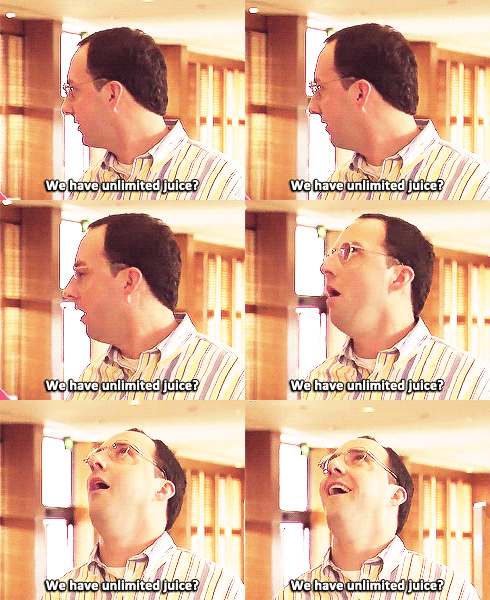
By the end of our trip, I was obsessed. I felt like Buster from Arrested Development: