Showing posts with label soup. Show all posts

Wednesday, April 12, 2017

The art of the not sad desk lunch.


I have to admit, for someone who brings lunch to work at least 80% of the time, the phrase "brown bag lunch" makes my heart sink a little. I've never been much of a sandwich gal - the insides slip and slide as you bite into it, and at the end of the day it's cold and dry. You have to buy enough cold cuts or fixings at a time that the deli slicer doesn't glare at you for getting 1/16 lb. of every meat and cheese, so you eat the same sandwich day after day. I'm not a big condiment person, much preferring pan drippings, gravy and broths to squeeze-bottle drizzles.

In school, there weren't many options - can you imagine the pandemonium if all parents sent their kids to school with food that needed to be microwaved? My kids are going to be those poor weirdos who bring to school a whole turkey leg or last night's braise in an insulated container, and all their friends will have brightly colored Lunchables and PB&J. But one of the perks of adulthood is office kitchens with microwaves. But with great power comes great responsibility: adult lunching goes best if planned out...that's how you avoid the sad desk lunch.

Those who know me would be completely unsurprised to learn that I have a meticulously planned spreadsheet that helps me plan breakfast, lunch, snack and dinner every day of the week. It's kind of a soothing ritual...every weekend I sit down in my cozy chair and play "Meal Plan Tetris":

  1. Check the upcoming week's schedule for lunch meetings, dinner dates, etc. (these are free spaces: block them off).
  2. Check the freezer for leftovers: I'm pretty careful about packaging leftovers so they're easy to use: single servings of soup, manageable portions of large batches of ancient grains, pre-measured quarts of broth/stock.
  3. Select dishes by looking for inspiration/backlogged recipes: my Pinterest board, magazine clippings and cookbooks.
  4. Strategically plan when to cook/how to repurpose ingredients throughout the week: Monday's roast chicken is Tuesday's salad protein; the quinoa for Tuesday's salad is also Wednesday's breakfast bowl base. Don't pick a busy night to make something with a long cooking time.
  5. List daily prep planning to make weeknight cooking a breeze: Know when to defrost things so they're ready to use; lunch doesn't have to be leftovers -- you can build all the components of a dish across multiple days so no one night is a slog of cooking chores and clean-up.
It may sound like a lot of work, but it keeps me sane during the week and allows us to eat home-cooked meals without getting bored from repeating leftovers meal after meal. Most importantly, it makes it possible not to have sad desk lunch -- don't you have enough to worry about with that big presentation this afternoon? Planning is 80% of the battle; the rest is execution.

This little beauty included leftover barley, weekend vegetable stock and a handful of spinach unused from an earlier salad (already washed and on the cusp of wilting); lentils yet to be repurposed:

Sweet Potato and Coconut Milk Soup with Black Lentils and Barley (I substituted the barley I already had for the brown rice I did not have, and I added spinach)

Saturday, January 30, 2016

South by Southeast (Asian).

After all-I-could-eat butter chicken, naan and paneer in Delhi, I noticed there was also a lot of Thai and pan-Asian food in India. As you may remember from my epic 2011 Soupbet battle (whose archives appear to be buried deeper in the Internet than I can find anymore), I kind of go into withdrawal if I haven't had noodle soup in a few days.

Fortunately (even at the wedding) there was noodle soup to be had! I must confess that I had more than one bowl:

Yes, you're seeing two kinds of noodles in there: wheat noodles and bean thread noodles. I was in heaven.

The rich, coconutty, slightly acidic soup haunted me all the way home, so the first dinner stateside I cobbled together a winter-warming Thai coconut chicken soup (tom kha gai). My usual approach for replicating dishes is to Google a few recipes and triangulate my own, and it proved useful to develop the general flavor profile: coconut, lemongrass, ginger, lime, chili and fish sauce. My finished product was less rich and less yellow (a little more curry paste and coconut milk likely would have gotten the consistency closer), but the flavor was spot-on.

*

Tom Kha Gai
Serves 4 (hungry people)

2-3 baby bok choy


1 lb boneless chicken breast
1 T corn starch
1 T oil
1/2 onion, minced
2 garlic cloves, minced
2 T green curry paste
5 c chicken stock
1 15-oz can coconut milk
1 stalk lemongrass
1" piece ginger
1-2 limes
fish sauce (1 T, to taste)
8 oz mushrooms
2 T cilantro, minced
salt and white pepper to taste
a few drops sriracha
bean thread noodles for two (this is subjective :), but one knot is usually enough)
wheat noodles (Asian noodles if you have them, spaghetti is fine if not) for two

Heat oil in a medium pot over heat. Saute onion and garlic for 3 min. Add curry paste and saute for 3 more min. Add stock and coconut milk and bring to a boil, then simmer over low heat.


Bruise the lemongrass stalk (smash it a few times with the back of a heavy knife), then add to simmering liquid with ginger. Zest and juice limes, then add half the juice and zest to the brew. Slice mushrooms, and simmer all for 10-15 min. Season with salt and white pepper.

Meanwhile...
Wash and cut up baby bok choy into 1/4-1/2 inch strips (crosswise).

Cut up chicken into slices/small cubes and season with cornstarch, salt and pepper; set aside.

Cook noodles: boil wheat noodles in salted water according to package directions. Soak the bean thread noodles in hot water to soften.

After simmering for 10-15 min., remove whole ginger and lemongrass pieces from broth. Add chicken and bring to a boil, cooking for about 3-4 minutes or until opaque all the way through. Add bok choy and barely bring back to a boil. Add fish sauce and remaining lime juice and zest to soup, then taste and adjust seasonings as needed. Season with cilantro and a few drops sriracha for additional heat; add drained noodles and enjoy.


Sunday, April 19, 2015

Spring greenery.


More signs of spring:
  1. We signed up for a summer CSA (community supported agriculture): a friend recommended Land's Sake from the seemingly endless options popping up as the model gains popularity...I did a couple farm boxes when I was in D.C., but I never subscribed long term. We pick up our first box in late May/early June - stay tuned!
  2. My biscuit recipe doesn't need as much milk (the dryness of winter is finally disappearing, and I can usually add/subtract a tablespoon or two of milk depending on the season)
In celebration of all the greenery popping up around us, we had a very green dinner last week. As promised, here's a recent recipe I discovered for minted pea soup...though the concept itself is by no means a new idea, I experimented a bit with some fridge leftovers and made a couple (green) accompaniments to round out this classic, spring green dish.

Honey-and-lemon-scented goat cheese with pistachios on toast:


And a little lemony dollop on top of the soup:

I adapted a recipe tailored for Thermomix, but here's how you could easily do this on a normal stovetop (use a blender/immersion blender at the end). It's super fast, bright and simple...easy-peasy.

Spring Pea Soup with Mint
Serves 4

3 T butter
1 small onion, diced
4 c frozen peas
2-3 c vegetable stock (depending on how thin you want it)
salt and pepper to taste
1/2 c mint leaves

Melt butter over medium heat in a medium pot. Cook onion for 6-8 minutes, or until softened and translucent. Season with salt. Add peas and 2 c stock, and bring to a boil. Lower heat and simmer for 5 minutes. Add mint and turn heat off.

Puree until smooth, season with salt and pepper to taste. If you want a thinner soup, add more stock as desired. Serve hot or cold, with a dollop of honey-and-lemon-scented goat cheese.


Honey-and-Lemon-Scented Goat Cheese

6 oz goat cheese
zest of one lemon
drizzle (~2 t) honey

Mix. (Yep, it's that simple.)


Monday, April 13, 2015

(Thermo)mixing things up.

Spring has shown itself! Today the temperature stretched above 70, and not a raindrop in sight. Grocery stores are starting to flaunt their farm stand/local produce (early Vidalia onions, brave lettuce, tender asparagus, even tiny sweet strawberries).

I love the start of every new season for its delicious hallmarks: new life peeking in the spring; patio grilling and warm, sun-ripened fruit all summer; apples and squash-filled fall recipes; and slow, comforting braises and hearty soups all winter. I actually find soups appropriate for all seasons, depending on how you prepare them and what ingredients you're showcasing. Thanks to the recent acquisition of a step-up converter, we have been bridging the gap between seasons by finally experimenting with one of our wedding gifts: a Thermomix (step-up converter to the right).

Imagine a tool which can replace your food processor, stove, blender and steamer (for those of you lucky enough to have space for one), among other appliances...enter Thermomix: you control the time, temperature and speed of a chopping/stirring mechanism (and it makes a pleasant chiming sound when the time is up!):

Why the step-up converter? Because, according to our family friend who gifted it to us, the European version is superior. (The converter is, by the way, smaller than a bread box and weighs 3-5x that of the Thermomix itself...my electrical engineer husband says, "That's how you know it'll work.") The upside: it's awesome...a truly remarkable machine which I am excited to experiment with. The downside: the recipe book is entirely in Spanish (beginning Spanish taught me "What time does the train arrive," but not the names of most ingredients and technical cooking terms).

We've been experimenting with pureed vegetable soups (the blender element makes it ideal for this purpose):

A smoky, creamy adobo butternut squash soup with just a touch of heat:

A not-so-successful asparagus soup (lack of success mostly due to my clumsy recipe conversion):

And perhaps my favorite, a spring pea and mint soup: (post to follow -- this one was exceptional).

The Thermomix makes quick work of chopping: (this was a two halves of an onion 10 seconds ago...no tears!)...

...and can turn chunks of raw butternut squash...

 ...into frothy, velvety goodness in under twenty minutes (no cream required):

Just beware the steam (it's hot!):

It can even multi-task (steaming asparagus in the basket above the main bowl):

The Thermomix online community is robust too...there are recipes for everything from cake to Hollandaise sauce. Looking forward to lots of experimentation! (We're enjoying early tests so far.)

Wednesday, March 11, 2015

Waste not, stock pot.

Earlier this year, I posted three new-year's food resolutions:
  1. Cook simpler on weeknights (save the big-bang meals for weekends)
  2. Minimize food waste (mostly in the form of being more clever about how I use what I already have in the pantry, fridge or freezer)
  3. Explore more ways to extend my love of food (suggestions welcome)
I've been doing better on #1 and #3 (stay tuned), but #2 is probably my most recent area of focus. True, it takes a certain amount of increased attention to be constantly aware of what's hanging out in your pantry/fridge/freezer, but it's been an interesting challenge. The easiest new habit I developed is saving all trimmed vegetable bits in a freezer bin, which is periodically emptied into a pot of boiling water to make vegetable stock.

I can't tell you how satisfying it is to take this...

...and make it into this...

...which, in turn, gets made into things like this:

I've made a few batches of veggie stock now, and I've learned a thing or two:

  • Keep a plastic bin in the freezer so you can easily add to it (it fills quickly, trust me; I have a two-quart sized container, and it fills in about a week and a half)
  • Vegetables with less water content freeze better
  • Basically you want tough parts of plants - they'll hold up to a good boiling and give out flavor without disintegrating
  • Starchy vegetables (like potatoes) make the broth cloudy
  • Colorful vegetables (red chard) will dye the broth 

On my shortlist:

  • Mushroom stems
  • Parsley stems
  • Carrot peel
  • Celery ends
  • Onion trimmings
  • Brussels sprout ends
  • Broccoli stems
  • Eggplant/squash ends
Basic recipe: Cover your vegetables with water (I use a five-quart pot for two quarts of frozen vegetables). Add aromatics (bay leaves, peppercorns, herbs dried up in the fridge past their prime) and salt (~2 t coarse salt for the aforementioned amounts). Cover and bring to a boil, then uncover and simmer for 45 min. Turn down the heat, re-cover and continue simmering for 45 min.

Yield: 2 1/2 quarts

Wednesday, December 4, 2013

In food company.

I hope everyone had a wonderful Thanksgiving last week!

I don't know anyone who doesn't love eating...but it's always a special treat to get friends together who all love to cook too (as you may recall, my dearest friends in DC were dubbed "Potluck People"). A few weeks ago, five of us brought a favorite dish for a fall dinner party:

Jason's roast carrot salad: (I can't say I've ever featured carrots quite as magnificently as Jason's duo; the oven-roasted spices were a delightful, rich contrast to the tangy crème fraîche in both recipes)

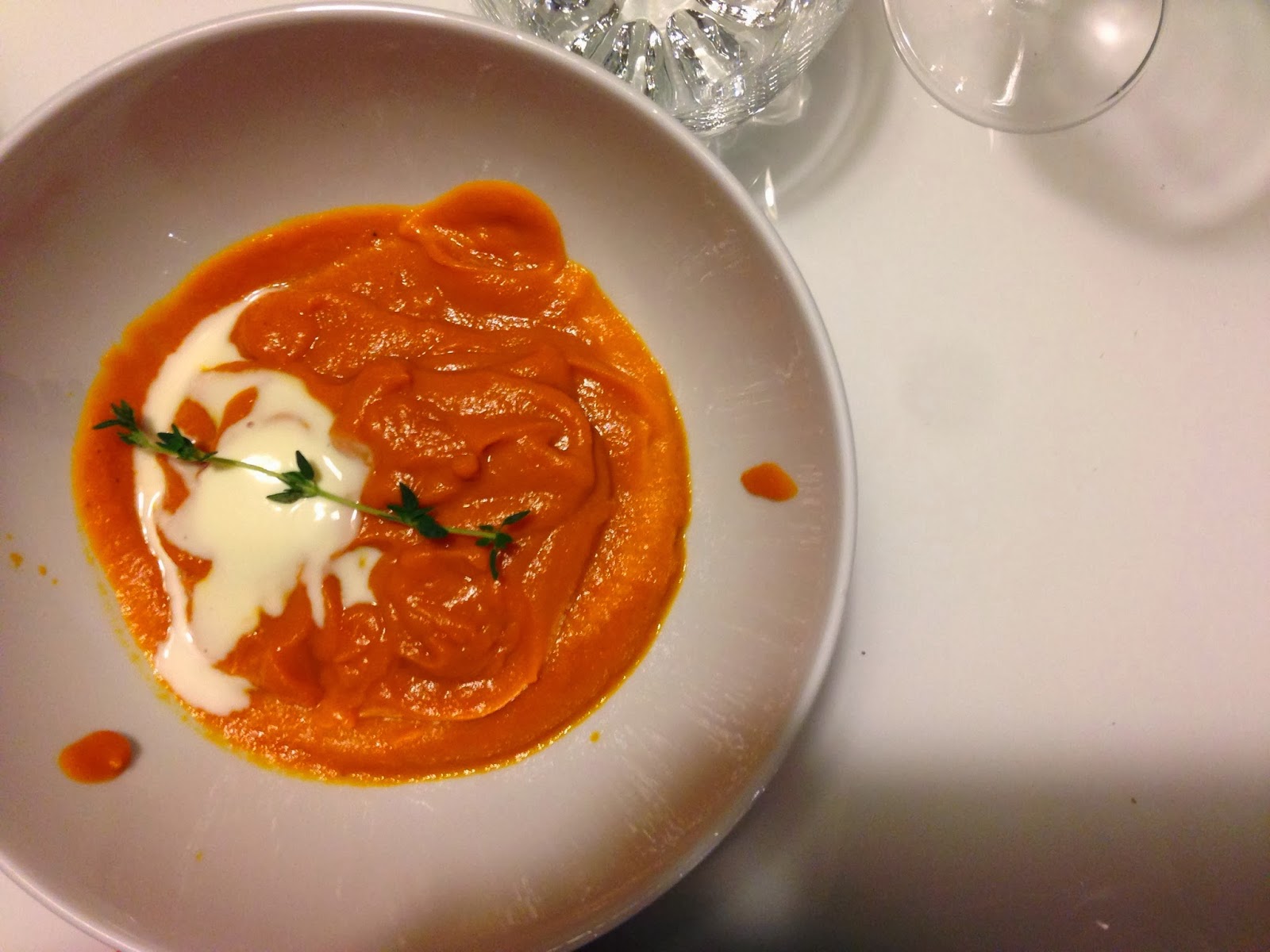
Followed by roast carrot soup: (Officially my favorite take on a velvety classic)

Lilly's Boeuf Bourguignon Ã  la Julia Child: (Cozy and splendid for a cold fall evening - with that all-day chef's love-taste)

My mini chocolate mousse cakes: (Suzy McMullen meets mousse, ganâche, toasted hazelnuts, and raspberries)


I think the logistical key to any dinner party is being aware of how much time dishes need in the oven and/or on the stove top, as everything needs to be timed out (as opposed to a larger potluck-style gathering where dishes can come and go as their chef-owners). We each prepared components of the dishes at home and then assembled and plated at our gracious host and hostess's home.

I love large events such as Friendsgiving (more on that to come), but intimate dinner parties give us all a chance to sit down at a table and enjoy...and a good time was surely had by all.

P.S. - Food52 is a fabulous website-exchange-community-resource-center-marketplace that everyone should get to know.

*

Roasted Carrot Soup
(from Food52)

Serves 4

6 to 8 large carrots (about 1 3/4 lb.)
1/4 c olive oil
Salt
6 c low-sodium vegetable stock
1 inch-long piece ginger, peeled
1 sprig thyme, plus more for garnish
1/2 large sweet onion, chopped
2 large garlic cloves, chopped
Freshly ground black pepper

Peel and cut the carrots into 1/2" pieces. Toss carrots on a foil-lined baking sheet with 2 T of olive oil and sprinkle generously with salt. Set an oven rack 6-8" from the heat source and turn on the broiler. Broil carrots until they brown and soften, turning them with a spatula every 5 minutes or so; this should take 15-20 minutes.

Meanwhile, bring the stock to a boil and infuse with ginger and thyme by simmering gently for 15 minutes. Brown the onion over medium heat in a medium stock pot with the remaining olive oil, stirring frequently. Toast the garlic with the onion and oil, then add carrots. Remove the ginger and thyme from the stock and add the stock to the pot with the onions and carrots. Bring to boil and simmer for 5-10 minutes, until the carrots are soft enough to puree.

Use an immersion or a standard blender to puree the mixture until smooth. Adjust consistency if desired by adding more stock or water. Add salt and pepper to taste.


Carrot Avocado Salad
(from Food52)

2 lb. large carrots quartered and cut into 3" segments, peeled (about 4 c)
Kosher salt
1 orange
1 lemon
1 t cumin seeds
2 medium garlic cloves
1 T fresh thyme leaves
1/2 c extra-virgin olive oil
1 t red wine vinegar
1 t red pepper flakes
Freshly ground black pepper
1 T sugar
1 avocado, cut into 12 wedges
2 c mixed baby sprouts, herbs, and microgreens
1/4 c crème fraîche
2 T toasted sunflower seeds
2 t toasted sesame seeds

Adjust an oven rack to the center position and preheat the oven to 450*F. Place carrots in a saucepan and cover them with cold water. Season with salt, set over high heat, and bring to a simmer. Reduce the heat to medium and simmer until tender, about 10 minutes. Drain the carrots and transfer them to a medium bowl.

Cut the orange and lemon in half and juice half of each one, reserving the juice and the remaining halves. Combine cumin, garlic, thyme, 2 T olive oil, the red wine vinegar, red pepper, 1 t orange juice, and 1 t lemon juice in a blender until smooth. Season the marinade to taste with salt and pepper. Add the marinade and the unjuiced citrus halves to the carrots and toss to combine. Spread the carrots and citrus halves on a rimmed baking sheet and bake until the carrots are slightly shriveled with a few brown spots, about 20 minutes. Allow the carrots to cool to room temperature.

Meanwhile squeeze the juice from the roasted citrus halves into a small bowl. Add the remaining fresh orange juice, lemon juice, remaining 6 T olive oil, and sugar. Season the dressing to taste with salt and pepper, and whisk to combine. Divide the carrots and avocado slices onto four plates. Divide the greens among the plates on top of the carrots and avocado. Add a tablespoon of crème fraiche to each salad. Sprinkle sunflower seeds and sesame seeds over each plate. Drizzle dressing over and around each salad (reserve any remaining dressing for another use), and serve immediately.

Sunday, December 23, 2012

Oooooh-mami!

I'll never forget this particular lesson in flavor-power my mom taught me when I was little: we were making a traditional Chinese dish of stir fried vegetables, meat, and mushrooms sitting over a bed of crispy, pan-fried noodles. The night before, my mom soaked a handful of wrinkled, dried mushrooms in hot water, and the next day pulled them out of the microwave all puffed up and reconstituted. Dried shiitakes have so much more flavor than fresh -- something about the drying concentrates all the flavor and seems to multiply. Helping to prepare the dish, I squeezed out the mushrooms so they could be sliced, and then tossed the bowl of soaking water.

"Wait!" my mom said as I dumped the water into the sink. She smiled and said, "I was going to use that." Evidently, the good flavor from the mushroom water serves as a flavor boost, though not specifically called for in the recipe. Lesson learned!

As many of you probably know, there are five recognized tastes: sweet, salty, sour, bitter, and umami -- umami is that savory, meaty flavor that's making your mouth water right now. Got it? Mushroom happens to be one of those foods that -- while not a meat itself -- can create an umami-richness of its own, which helps explain why the mushroom-water is so tasty.

The weather has been appropriately wintery the last few days, inspiring one of my favorite soups. Heidi Swanson's mixed mushroom soup is the most umami-goodness I've ever experienced, packed into one little bowl. The amazing thing is that there's no meat in it. I used to think that soy sauce and sesame oil could only lead to "Asian"-flavored food, but not in this case. The mushrooms, soy, and sesame created a satisfying, warm-tummy feeling for hours. I've made the recipe with chicken stock before, but the vegetable stock (with some of the dried mushroom-soaking liquid, of course) goes a long way. If you're looking for a hearty winter soup (err...and you like mushrooms), this one's for you. The chewy mushroom chunks and toothsome barley make it ultra-satisfying, and the little bright chive bite balances the richness.

*

Mixed Mushroom Soup
(from Heidi Swenson)


1 lb assorted mushrooms, cut into bite-sized pieces (I used some reconstituted dried shiitakes as well as fresh creminis)
fine grain sea salt & freshly ground pepper
1 medium yellow onion, finely chopped
1 medium red onion, finely chopped
2-3 T soy sauce
1 1/2 c cooked pearled barley
5 c vegetable broth, plus 1 c soaking liquid from dried mushrooms
1/4 t toasted sesame oil
finely chopped chives or scallions

Heat two tablespoons of olive oil over medium-high heat in a large soup pot. Add mushrooms and season with salt and pepper. Cook until mushrooms are browned, stirring a few times (5-8 min). Remove mushrooms and set aside.

Using the same pot, heat the remaining tablespoon of oil, still over medium-high heat. Cook onions until soft (4-5 min.). Add two tablespoons of soy sauce, barley, and then the vegetable broth. Bring to a simmer, then reduce the heat a bit. Add the mushrooms and cook another 10 minutes. Stir in the toasted sesame oil and taste. Feel free to add more soy or sesame to your liking (the salt level will depend on how salty your broth was). Sprinkle with chives and serve.

Friday, May 4, 2012

Ippudo, you-ppudo, we all scream for Ippudo.


A couple weekends ago Nick and I were in New York with my parents, celebrating our engagement. On the last day, we braved the rain and crowds to try to squeeze in at Ippudo, anecdotally acclaimed to be one of the best ramen restaurants in Manhattan. Situated in the East Village, Ippudo is always crowded, but the food is phenomenal. I had been once before with a friend, who warned me of the long wait times because of its popularity and limited seating area. On that particular rainy Sunday, the front entrance was packed with people and umbrellas, held captive by the tantalizing smells from the kitchen. For two, our wait was just over an hour (not bad!), and were seated -- ravenous -- at about 2:30pm.

Everything in Ippudo is a blur: the servers whiz by with steaming bowls of noodles and rich broth, and everyone is always shouting to greet customers and call in orders, adding to the buzzing atmosphere.

We started with flash-fried shishito peppers with yuzu salt:

(The citrus salt cut the hot oil and gave that zing that makes the corners of your mouth turn up.)

I ordered the Akamaru Modern with a seasoned, soft-boiled egg -- an umami explosion with lots of garlic and sesame:


Nick ordered the Miso Ramen with a GIGANTIC ball of ginger on top and a poached egg:

The anticipation and long wait had made me extra-hungry...I ordered extra noodles halfway through. Extra noodles, or "Kae-dama," is a common offering in ramen restaurants, but this was the first place I had ever seen a policy:

"When you have almost finished your first serving of noodles, order by saying 'Kae-dama, please.' In a few minutes the server will bring you another 'ball of noodles,' and put it in the soup. At that time, you must have enough amount of the soup in the bowl to accommodate the new noodles, that is, you shouldn't drink much of the soup if you are going to order the Kae-dama."


Well, I got my Kae-dama, and I still managed to finish:

It's easy to see why Ippudo is so wildly popular.

Wednesday, April 25, 2012

East meets Central.

Introducing Moksa, a new(ish) pan-Asian, pan-entertainment establishment in Central Square. The place is, literally, a long, narrow set of rooms beginning with a bar in the front, a middle restaurant space, and a dance club in the back. Moksa serves up unique cocktails (each created for an animal in the zodiac) and artistic small plates sampling Indian, Malaysian, Szechuan, Japanese, Vietnamese, and Korean cuisine.

Before we get to the food, it's important to note that they got the zodiac-cocktails just right: Nick's "Eye of the Tiger" was Scotch-based, and my delicious "Shanti Shanti" included sparkling wine, Campari, and grapefruit sugar.


Thai green mango and papaya salad with tangy lime and crunchy peanuts (ribbons of color and flavor):

Fried chicken and mushroom wontons (a crowd-pleaser):

Miso-braised shortrib roti with ginger scallion sauce (so much umami, you don't even know):


Hand cut ramen noodles with pork belly and a five-minute egg (thick, chewy noodles, just as we like them; and a perfect egg).

Still curious, we added on a dan dan mein with spicy pork-mushroom ragu (a bit more hot than spicy)...and evidently I was so busy eating that I didn't capture it on my camera.

Conveniently located in Central Square, we'll definitely be back.

Wednesday, January 4, 2012

Cold nights, hot pot.

I hope everyone's settling in nicely to the new year (read: going back to work wasn't so hard today compared to yesterday).

A couple times while home over the holidays, we cooked up a traditional Chinese "hot pot" -- a boiling pot of broth at the center of the table and plenty of meat, veggies, and noodles to cook in little baskets with your family. Oddly enough, I had never done hot pot with my family growing up. When I started working for my current team, they took me to Uncle Liu's in Falls Church, but until then, I had never participated.

Here's how hot pot works:

Light a fire in the middle of a table (we used a little butane burner).

Bring stock of choice to a rolling boil (we made chicken stock and ladled out a pot).

Provide each diner with a plate, bowl, soup spoon, pair of plastic chopsticks (for eating cooked meat), pair of wooden chopsticks (for cooking/handling raw meat), and a special mini basket (to hold food as it cooks in the broth).

Thinly slice raw meat onto plates with mini tongs. Assemble vegetables and noodles for cooking. Dish up a variety of savory, sour, and spicy dipping sauces.

Every person has his own "cooking" utensils; because the meat is so thinly sliced, you can cook it quickly in the boiling soup, a piece or two at a time. Pick up meat slices and drop into the baskets; submerge baskets and cook for 10-30 seconds, depending on what you're cooking (careful, sometimes if the soup is boiling rapidly enough, the meat gets away!)

Enjoy piping hot, dipped in delicious sauces.

After you've cooked all the meat, keep soup boiling and add vegetables to soup. Once the veggies are cooked, serve into individual bowls and add noodles to boiling broth. Serve noodles and soup with veggies, and enjoy!
 
Our menu: (we were spoiled with fresh seafood flown in from L.A.)

  • Conch
  • Razor clam
  • Halibut
  • Sole
  • Mussels
  • Beef
  • Choy sum
  • Enoki mushrooms
  • Tofu
  • Cellophane noodles
  • Rice cake noodles
There's something spectacular about an already-tasty broth that has been cooking and boiling seafood and beef and vegetables and noodles (a natural thickening agent). With a little purring fire at the center of the table, hot pot is a truly cozy event.