Wednesday, February 28, 2018

China, Part II: And now for something completely different.

Now that you're oriented (no pun intended) to our China trip, we can dig more into the food. Our journey took us to three fairly distinct parts of the East Coast: Hong Kong was farthest south, Ningbo and Shanghai more central, and Beijing up north. Not surprisingly, we ate different things everywhere.

We also ate different things everywhere. When I go to Chinese restaurants in America, I have a problem: I don't read much Chinese (I easily 10xed my character recognition during our trip), and I don't recognize the English descriptions of the dishes I like. So I usually end up crossing my fingers and listing seven or eight dishes I'd like to eat and hoping they're on the menu -- so far, I have a pretty decent hit rate. In China, my parents took care of all the ordering, so we were in good hands. Of course, while we enjoyed plenty of the classics, we got to try some very different foods I'm pretty sure I'll never find in the U.S. Today's post is a round-up of the most new (and unusual) things we tried.

Hong Kong

There wasn't much shocking in Hong Kong...delicious for sure, but overall mostly familiar. Searching my 1000 food photos (no exaggeration), I found this little guy, a black sesame glutinous rice dumplings rolled in peanut dust (at the Jumbo Floating Restaurant, where my grandfather used to take important clients to lunch):

We have only ever had them in soup before - these were delicate and had that wonderful nutty flavor from the black sesame.

Ningbo

We had so many dishes (and fishes) which I have no idea how to translate to English...my mom kept saying, anxiously, "I'm not sure you'll like the food in Ningbo," and we didn't understand what she meant until we got there. The food was delicious, don't get me wrong -- but when food comes to the table in Ningbo, it's often intimidating: benign-looking fish are filled with bones, and pretty much everything else has a shell (or two) you have to fight in order to get through to the succulent prize within.

Tiny freshwater fish (my cousin showed us a technique where you basically push the meat gently off the bones, lining up your chopsticks parallel to the spine/perpendicular to the bones; any other method was sure to win you a spiky mouthful)...Nick couldn't resist the progressive photos ending with a truly cartoonish -- if also a tad macabre -- head and tail:


Tiny snails:

The aforementioned "blood cockles":

(Evidence of) shell-in peanuts, shell-in shrimp:

But not everything was intimidating! We discovered a new dumpling which takes the best of a chashu bao/BBQ pork bun (a soft, fluffy yeast bread exterior) and a potsticker (gingery pork and cabbage filling, crispy fried bottom) and marries them into something called sang zin man tao, literally translated to "raw seared bread," AKA a rival so exquisite they could potentially dethrone xiaolongbao/soup dumplings from the top spot:

Shanghai

We zipped up the coast by train to Shanghai, where we ate our weight in xiaolongbao but also found some new dishes of interest....

An amazingly subtle and delicate sweet soup with fermented rice (slightly sour), mini black sesame dumplings and suspended gwai fa: a gorgeous, sweet golden-orange flower which was everywhere in Ningbo (the streets were pleasantly perfumed with their light scent):

And here are the flowers from the tree-lined streets of Ningbo:

A crazy-looking fried fish with sweet-and-sour sauce, which I took to calling "porcupine fish" instead of learning the proper name (oh well, another dish I'll never be able to recognize on an American menu). It's kind of like a bloomin' onion, except it's fish...they cut it such that when they deep fry it, it blooms into this glorious pouf of crispy spikes:

Beijing

Another high-speed train later, we arrived at our last stop. More to come on one of my absolute regional favorites, lamb hot pot, but the most exotic dishes we ate in Beijing were all at a tiny, hole-in-the-wall restaurant specializing in Imperial-style cuisine. I had never tasted more interesting and curious flavors in Chinese cooking before; it was all served omakase (the chef sent out whatever he wanted) and tapas-style.

Cold appetizers (from left to right, top to bottom): pork belly, bonito-dusted cucumber, pickled carrots, wasabi napa cabbage, an electric green soy-based cake, poached chicken with some kind of sauce, and the dark horse, chicken liver mousse (I literally said, "Try the grey stuff...it's delicious!")

No joke, over 20 dishes came to the table (see fried fish photo below). Maybe it was because we had climbed the Great Wall that day and were exhausted, but we put it all away without much trouble. A few other highlights included an unbelievable, crispy-skin pork belly served over hot sticky rice with a perfectly balanced soy sauce:

A crispy fried fish (center plate; it was so perfectly cooked that you could literally eat the fins...and we did):

And for dessert, tiny, tart fruits poached in jelly (Mom and Dad said they were something like crab apples), a refreshing and crisp finish to our huge meal:

*

We were so fortunate to try all of these amazing new dishes...we got over the intimidation factor pretty quickly and dug into everything with gusto. If I think back thirteen years ago to when Nick and I started dating, never would I have imagined how readily he would embrace this experience. As I said to him one night, "You know you’ve come a long way when the most familiar and comforting-looking dish on the table is head-on shrimp."

Monday, February 19, 2018

China, Part I: Family roots BINGO (NINGBO).

Where has the time gone? Since my last blog-delay excuses, we’ve celebrated Christmas and New Year, welcomed my sweet nephew (Simon), and I went on a work trip. Friday we celebrated Chinese New Year with a fabulous double-hot pot at a friend’s house and rang in the Year of the Dog.

Taking advantage of the long weekend and holiday spirit, I decided to get started on a long-overdue mini-series of posts about our China trip from the fall. Over 20 years ago, I visited Hong Kong for the first time with my family: it was a couple years before the Handover, and I was too young (and it was too hot – who visits Hong Kong and Singapore in July??) to appreciate much besides frequent trips to Häagen Dazs with my uncle.

My parents have gone back quite a few times, and I’ve wanted to go with them in the past, but it’s a minimum two-week commitment for which Nick and I have rarely had vacation days to spare (after years of long-distance, there was our honeymoon to account for, plus our India trip…poor us). This year neither of us had changed jobs recently (hurray!), so we accrued enough vacation time to put toward a seventeen-day trip to Asia. I jokingly called it "birthright," but in a way it was pretty appropriate given how much family history and culture we go to see:
  • My parents both grew up in Hong Kong
  • Their pre-Hong Kong families were from villages (Shanjielingcun and Jhong Cun) near Ningbo…
  • …Which makes us culturally Shanghainese…
  • …and you kind of can’t go to China without visiting Beijing
There’s so much to see and do (and eat) in just seventeen days, so we did a good amount of planning with Mom and Dad in advance, making the “must-do” list by city. OR, as I retrospectively put together, the “Family Roots BINGO” card (or, in our case, NINGBO) to summarize (gray boxes indicate food experiences/click to view larger image):

(NINGBO card footnotes* below.)

While this quick summary hardly captures all of our adventures, it's safe to say that we wouldn't have had nearly as rich (nor tasty) an adventure if Nick and I had tried to go alone. We were so lucky to have my parents as tour guides for this trip, and it's one we'll remember for a long time.

* NINGBO Card Footnotes *

Ningbo
  • Nian Gao: Sliced rice cakes, or pretty much the best thing ever. They're a little chewy, almost like gnocchi, and they can be sweet or savory, in soup or stir-fried. While you'll find them in Korea, Japan and other parts of China, nian gao is kind of a regional specialty.
  • Wong Family Plot: The grave site of my Mom's grandfather, about an hour outside Ningbo -- my parents had just learned about it in the last couple years and had the site restored.
  • Dragon Well Tea: A specialty green tea, the regionally protected (A.K.A. the Champagne of Dragon Well) is "Dragon Tongue" tea. We drank lots of this in Ningbo, and we also visited the beautiful, rolling tea fields.
  • Chu Ancestral Hall: 30+ generations of my dad's side of the family are commemorated in a building, another hour outside Ningbo, where each generation's family historian keeps track of male lineage chiseled into a marble wall (and the rest of us are written in a book) -- yes, this is for real -- another gem our family just discovered in the last couple years.
  • "Bivalves": These suspicious-looking freshwater creatures are also a local delicacy...known as "blood cockles," they contain a red liquid that (only) looks like blood. Try anything once?
Shanghai
  • Xiaolong Bao: Soup dumplings! Delicate wrappers stuffed with pork, cabbage and aromatics sitting in a puddle of delicious broth which should be slurped out before enjoying the rest. These were at a tiny restaurant in Shanghai (Dad asked the hotel concierge, "Where do you eat around here?").
  • Xintiandi: A.K.A. the "French Concession," or old French Quarter, this little European-style part of Shanghai is a posh restaurant and shopping district, known also for being home to the site of the first congress of the Communist Party of China.
  • The Bund: The waterfront district of downtown Shanghai, where the famous skyline sits.
  • Yu Yuan: A gorgeous garden in Old Shanghai, complete with a snaking dragon which tops the extensive garden walls.
  • Nanjing E-W Road: A famous shopping street which runs, you guessed it, East-West through the city. This night photo shows the sign of the watch company where my dad's father apprenticed.

Hong Kong
  • Peninsula Hotel: On the Kowloon side, this famous hotel opened in 1928 and was the site of historic meetings during WWII...my mom's dad's company once made furniture, upholstery and drapes here.
  • Mom's School: St. Paul's Co-Ed; this is the view from the Peak Tram (Nick's fancy camera snagged it, even in motion). Fun fact, said in (my) sloppy Cantonese, "St. Paul" gets mispronounced, "St. Pineapple."
  • Won Ton Mein: FREE SPACE!! This Cantonese specialty is everywhere in Hong Kong (this particular bowl is at the top of Victoria Peak at Mak's Noodle).
  • Victoria Peak: The highest mountain on Hong Kong Island (1,811 ft.) and a gorgeous park for walking and taking in views of the city and harbor below.
  • Dad's School: St. Stephen's boarding school, located in Stanley.
Beijing
  • Peking Duck: Duck-adent dinner at Da Dong, absolutely fantastic and classic preparation of crispy skin, juicy meat, paper-thin pancakes and fixings (for those who have never had Peking duck, it's kind of like the most amazing delicate fried chicken wrapped in a taco...what's not to love?)
  • Great Wall: One of the Wonders of the World (by a few different classifications)...there are multiple tourist entrances, and apparently we picked the steepest one. Took us a couple hours to climb up, and under an hour to get down, to give a sense of scale.
  • Tiananmen Square: (Translates to "Gate of Heavenly Peace") Massive physical and historic presence, heavily guarded.
  • Forbidden City: Historic Emperor's palace which today lets in 80,000 visitors per day to see museum galleries of artifacts, jewelry, ceramics, clocks and more.
  • Tian Tan: Temple of Heaven and gorgeous surrounding gardens. It took us three tries to get in per the confusing schedule, but we made it eventually and were rewarded by the sights.

Sunday, December 3, 2017

Caution: contents under pressure.

Hello, December! October and November were a whirl of travel: two and a half weeks in Hong Kong and China (Nick is still processing the photos, but I think the original count was over 200 pictures of food alone -- blog post to come), a dear friend's wedding in Chicago, and an early-observed Christmas in Seattle with the family. Though the travel has been great, between work and a seemingly steady stream of "grown-up" problems (e.g., our furnace and car both protesting the sudden winter temperature drop within two weeks of each other), the constant planning and rushing means I often find myself wishing more things were "set it, and forget it."

FORTUNATELY, as of my birthday this fall, I am the proud owner of an Instant Pot, a seven-in-one pressure cooker, slow cooker, rice cooker, steamer, sautéer, yogurt maker (I didn't realize that was a thing) and warmer. Never having been a fan of single-use appliances and kitchen tools, and having done much hand-wringing over whether or not to get a Crock Pot and/or pressure cooker, I was excited to find this little gem. For those of you unfamiliar with the cult following of Instant Pot, it's taken the cooking world and Pinterest by storm due to its versatility and efficiency (e.g., cooking one-minute quinoa, sterilizing baby bottles, making a day-long braise in under an hour). You can sear pretty effectively right in the pot, and then the pressure cooking provides enough steam such that browned bottoms melt away in the second step for easy clean-up.

I haven't fully familiarized myself with my new toy yet (see paragraph 1), but I did christen it with an Internet balsamic pork tenderloin which, while quite tasty, I should have guessed might be a tad dry for the technique (searing, then pressure cooking)...next time I'll try it with regular pork loin for a bit more fat, perhaps with more sauce. All told, including the sauce and resting time, the cooking time was about 25 minutes. For pork tenderloin, that's competitive with oven time, but mostly due to the time it takes to build pressure in the cooker (~5-6 minutes for me). The pork itself took five minutes once it reached pressure, and then three minutes for the pressure to release (an impressive jet of steam whistled out of the valve for an impressive amount of time). The pressure-building time, which can vary significantly from recipe to recipe, is NOT included in the crazy-fast cook times recipes rave about.

I must admit to a hilarious irony while giving Instant Pot a try: I felt incredibly under pressure the entire time. I had skimmed the manufacturer's instructions, but things moved so fast that there just wasn't time to refer back to them once we plugged things in. I was most anxious during the pressure-building phase as I hadn't known about it previously. Would dinner turn out okay? Was the pot lid going to get stuck as is often the dramatic case with pressure cookers on Top Chef? Would it explode if I did something wrong? Why wasn't the timer counting down yet? But when the steam successfully released in its steady stream signaling the end was near, I, too, exhaled happily.

I'll update you on my learning/key takeaways as I test new recipes and techniques. Though the pressure cooker functionality is a bit too fast for set-and-forget, I'll also be trying out the slow cooker functionality this winter.

Peering inside: (wave at your reflection in the shiny bottom!)

One-pot wonder: (sear before pressure cooking)

Cooked in a flash: (seriously, we had to pay such close attention getting acclimated over such a short period of time that photography has some gaps)

Resting: (while getting pan sauce going in the pot)

Carve:

Drizzle sauce:

Eat:

Sunday, September 17, 2017

Berry bliss.

Hello again, friends -- goodbye again, Summer! So much has happened in the blink of an eye. The last few months have been an exercise in spinning plates, developing patience and snagging sweet moments of peace between the madness. Plenty to be grateful for and happy about, but the pace has been more than I can remember in a while. As summer evenings cool into fall, I'm taking advantage of a sliver of downtime produced by some chicken and peppers on the grill to sip a glass of wine and fulfill a secret wish I've been thinking about all summer.

Starting in late spring, our grocery store stocks strawberries from Pell Farms, a New England gem which, hands down, has the best, sweetest, most consistent strawberries I've ever had. At a whopping $7/lb, they are tiny, deep red (all the way through to the center, which you could observe if you were to exercise self control and bite into one instead of shoving it whole into your mouth) and a perfect concentration of summer sun. Most days I ration them fiercely, slicing a scant few onto yogurt for breakfast or to brighten up a salad. It's funny, the things which seem outrageously expensive for what they are (even if under $10) and the other things we will splurge on (a great pair of shoes or a night out with friends).

Today for a little "me time," I washed and hulled a box of these beauties and sat down to blog and binge on as many as I wanted. It may sound ridiculous, but taking a moment to enjoy our string lights (in that magic hour before the mosquitoes come out), sip wine and eat berries seemed like an indulgence worth writing home about.

Wednesday, April 12, 2017

The art of the not sad desk lunch.


I have to admit, for someone who brings lunch to work at least 80% of the time, the phrase "brown bag lunch" makes my heart sink a little. I've never been much of a sandwich gal - the insides slip and slide as you bite into it, and at the end of the day it's cold and dry. You have to buy enough cold cuts or fixings at a time that the deli slicer doesn't glare at you for getting 1/16 lb. of every meat and cheese, so you eat the same sandwich day after day. I'm not a big condiment person, much preferring pan drippings, gravy and broths to squeeze-bottle drizzles.

In school, there weren't many options - can you imagine the pandemonium if all parents sent their kids to school with food that needed to be microwaved? My kids are going to be those poor weirdos who bring to school a whole turkey leg or last night's braise in an insulated container, and all their friends will have brightly colored Lunchables and PB&J. But one of the perks of adulthood is office kitchens with microwaves. But with great power comes great responsibility: adult lunching goes best if planned out...that's how you avoid the sad desk lunch.

Those who know me would be completely unsurprised to learn that I have a meticulously planned spreadsheet that helps me plan breakfast, lunch, snack and dinner every day of the week. It's kind of a soothing ritual...every weekend I sit down in my cozy chair and play "Meal Plan Tetris":

  1. Check the upcoming week's schedule for lunch meetings, dinner dates, etc. (these are free spaces: block them off).
  2. Check the freezer for leftovers: I'm pretty careful about packaging leftovers so they're easy to use: single servings of soup, manageable portions of large batches of ancient grains, pre-measured quarts of broth/stock.
  3. Select dishes by looking for inspiration/backlogged recipes: my Pinterest board, magazine clippings and cookbooks.
  4. Strategically plan when to cook/how to repurpose ingredients throughout the week: Monday's roast chicken is Tuesday's salad protein; the quinoa for Tuesday's salad is also Wednesday's breakfast bowl base. Don't pick a busy night to make something with a long cooking time.
  5. List daily prep planning to make weeknight cooking a breeze: Know when to defrost things so they're ready to use; lunch doesn't have to be leftovers -- you can build all the components of a dish across multiple days so no one night is a slog of cooking chores and clean-up.
It may sound like a lot of work, but it keeps me sane during the week and allows us to eat home-cooked meals without getting bored from repeating leftovers meal after meal. Most importantly, it makes it possible not to have sad desk lunch -- don't you have enough to worry about with that big presentation this afternoon? Planning is 80% of the battle; the rest is execution.

This little beauty included leftover barley, weekend vegetable stock and a handful of spinach unused from an earlier salad (already washed and on the cusp of wilting); lentils yet to be repurposed:

Sweet Potato and Coconut Milk Soup with Black Lentils and Barley (I substituted the barley I already had for the brown rice I did not have, and I added spinach)

Thursday, March 16, 2017

Work from home skillet.

Snow in March. I suppose that's just normal New England weather, right?

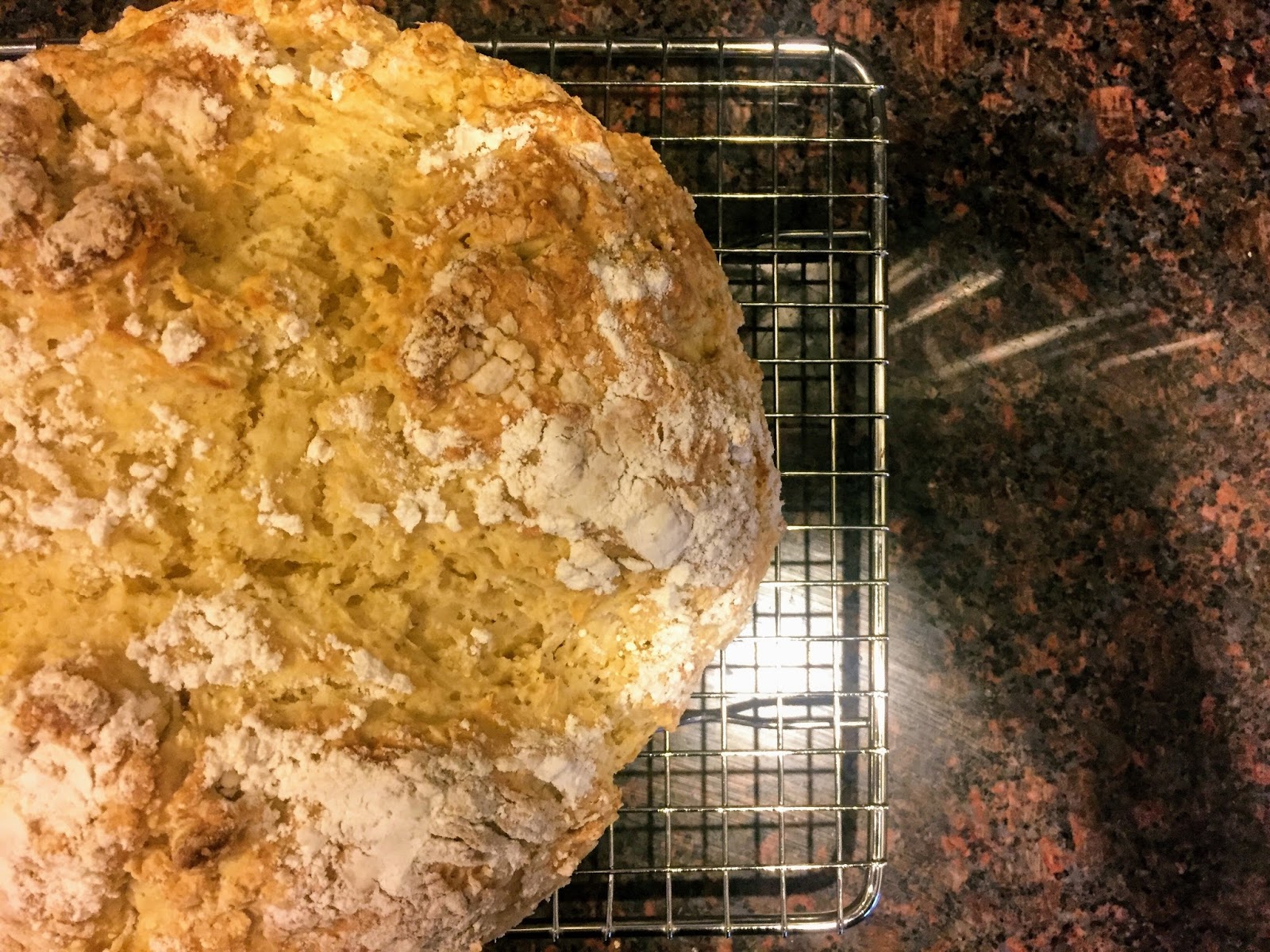
Tuesday marked our ~fourth snow day of the year. What that typically means is that Nick and I creep closer and closer to the fireplace all day long until we're toasting the bottoms of our feet by 5pm. I'm one of the fortunate type who is wildly productive working from home -- of course, we all have our days, but I'm batting a strong average for Winter 2016-2017. And it's not limited to work productivity; this week, for instance: by the time I'm normally rolling into the office (~9am), I had 1) slept an extra hour, 2) done a deck of cards workout, 3) baked a loaf of Irish soda bread and 4) sat down to work.

For those who observe the holiday, Tuesday was also Pi Day: 3.14. Having nothing really appropriate to fill a pie (I planned poorly), and also trying to use up some buttermilk from recent baking adventures (perhaps I planned well after all), I honored math's most popular ratio by bookending my day baking quick breads in a round cast iron skillet. Two breads in one day? Yes, you can have it all.

***A few words about quick breads: While not providing quite the same springy, crusty, airy satisfaction of yeast breads, quick breads are delicious in their own right and (as you might have guessed) quick: no time to rise, very little time to mix up. They get their leavening from baking soda mixed with acid (in my case, buttermilk), and if you use a cast iron skillet, you get a satisfyingly crusty bottom from the even, direct heat of the pan.

In addition to Pi Day traditions and celebration, about half way through the day our next door neighbor rang the doorbell to induct us into a time-honored neighborhood snow-day tradition: impromptu potluck dinners. I was at first excited and then immediately overcome by panic that I had nothing to bring, scant ingredients in my fridge, and a good amount of work left in the day. Cast iron skillet to the rescue again! I had just made a huge batch of chili on Sunday, so I dug some out of the freezer (I would normally never dream of bringing "leftovers" to a potluck, but chili is better leftover anyway), and decided to make cornbread as a side.

Look how perfectly I was able to use up the last drop of buttermilk on the second round (see recipe below for proof):

The best part of a snow day social? It has to be just a few steps from home, so we could stay longer and enjoy the excellent company with a glass of wine (or two).

Irish soda bread:


Cast Iron Skillet Cornbread:


*
(Food52 cornbread contest recipe winner from boozeandsusan)

1 1/2 c coarse yellow cornmeal
3/4 t baking soda
1/2 t coarse salt
2 large eggs
1 1/2 c buttermilk
1 1/2 c T maple syrup
4 T unsalted butter

Preheat an oven to 425*F. Heat a 9-10" seasoned cast-iron skillet in the oven for 10 min., until very hot. 

Combine cornmeal, baking soda and salt in a bowl. In a separate, large bowl, whisk together eggs, buttermilk and maple syrup. Remove the hot skillet from the oven and add the butter, swirling until it's melted. Working quickly, pour the hot, melted butter into the egg and buttermilk mixture, and whisk until combined. Add dry ingredients and whisk until just combined.

Pour the batter into the hot skillet and and bake until golden, 20-25 minutes. Allow cornbread to slightly cool before cutting.

Thursday, March 2, 2017

Good to Grey(t).


I've always been a cake kid. Scratch that, I've always been a frosting kid. I like my cake-to-frosting ratio to be about 1:1. I'll break the bottom off a cupcake and give it away in order to maximize the ratio. I generally reject muffins because they're just sad, frosting-less cupcakes.

I have strong feelings about cake and frosting.

Which is why when I discovered this amazing recipe by Tessa Huff (featured in Layered), I became completely obsessed. I learned two things:
  1. Swiss buttercream is NOT that difficult
  2. Egg whites freeze beautifully (I triumphantly was finally able to use leftover egg whites I had frozen when I made a chocolate pie that used nine egg yolks - see future post)
My classic "buttercream" frosting recipe is a bit of a cheat - butter/shortening + powdered sugar + vanilla + salt. I've always been intimidated by real buttercream because it involves cooking egg whites to 160*F and then whipping them into a frenzy with sugar, softened butter and some kind of flavoring. One key benefit is you can use much less sugar - perhaps because the egg whites are what are providing more of the body? - and the other is that you can infuse the butter with delicious flavors before adding to the egg-frenzy because you're less dependent on the firm butter texture holding up the whole thing. I must admit, I might be a convert.

This past weekend was the bridal shower of a very dear friend who happens to love London Fog lattes. When I found this recipe, it seemed like an obvious choice to honor the bride-to-be, and it has swiftly earned top-tier status in our house. For those of you not familiar with a London Fog latte, it's steamed milk with Earl Grey tea and vanilla. I used my classic family chocolate cake with Tessa's Earl Grey + vanilla bean buttercream and salted caramel topping. The frosting isn't overly sweet in general, and the bergamot is super subtle and floral.

Please, someone have a birthday, or a baby, or finish your taxes, or any occasion so I can make this cake frosting again.


Earl Grey Buttercream
(adapted from Tessa Huff)

2 c unsalted butter, at room temperature
1/4 c loose Earl Grey tea (I pulled open five tea bags)
4-6 egg whites (about 1/2 c + 2 T)
1 1/4 cup granulated sugar
1 1/2-2 vanilla beans, scraped
1/2 t vanilla extract
pinch of salt

Place 1 c butter in a saucepan with the loose tea. Melt butter over medium, then reduce the heat to low and simmer for 5 min. Remove from heat and let the tea steep for 5 min. more. Strain butter through a fine-meshed sieve set over a bowl, and refrigerate until it reaches the same consistency as softened butter, 20 to 30 minutes. Small bits of tea may remain in the butter - not a problem (especially since you'll be adding vanilla bean).

Place egg whites and sugar in the bowl of a stand mixer. Whisk by hand to combine. Make a double boiler with a few inches of water heated in a saucepan/place the mixing bowl on top (don't let the bowl touch the water). Whisking intermittently, heat the egg mixture until it reaches 160*F on a candy thermometer or is hot to the touch. Carefully fit the mixer bowl onto the stand mixer.

With the whisk attachment, beat the egg white mixture into a total frenzy on high speed for 8 to 10 min., until it holds medium stiff peaks. When done, the outside of the mixer bowl should be basically cool/room temperature. Stop the mixer and swap out the whisk attachment for the paddle.

With the mixer on low speed, add the vanilla bean/extract, tea infused butter, salt and remaining 1 c butter, a couple tablespoons at a time. Once incorporated, turn the mixer to medium high and beat until the buttercream is silky smooth, 3-5 min.